If you searched for "AI governance" and found yourself comparing Credo AI, Zenity, Noma, SurePath AI, and Straiker before landing here, you are at an important fork in the road. These are real products solving real problems. The question is whether the problem you have is the one they solve, and whether software is where your governance gap actually lives.
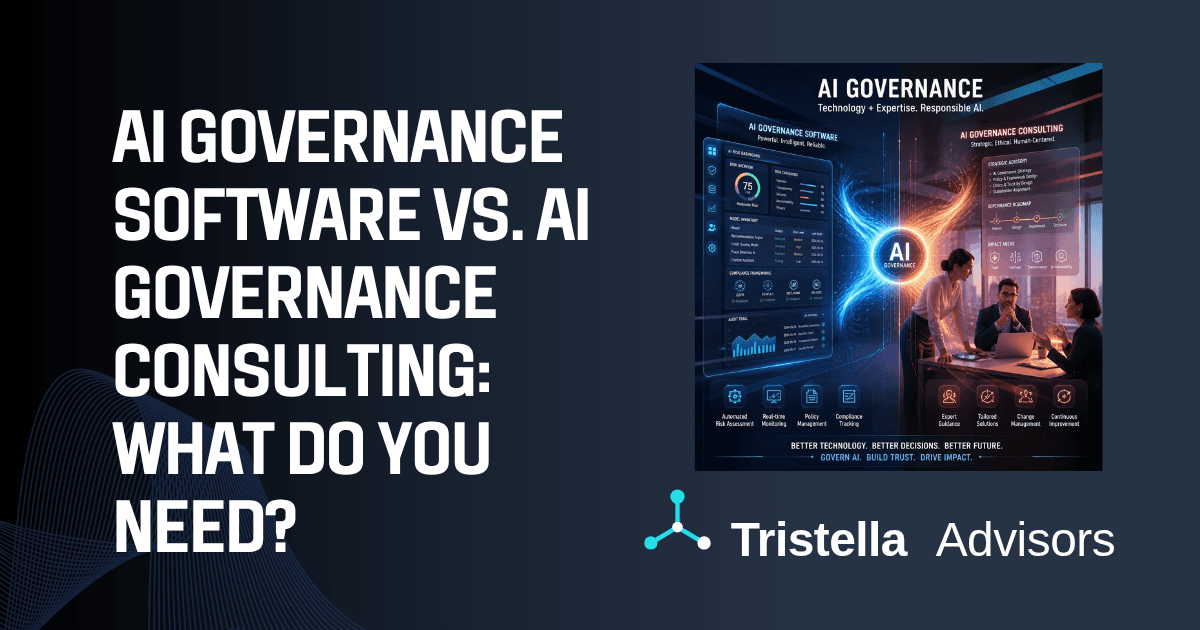
The short answer is that AI governance software and AI governance consulting are not competing choices. They address different layers of the same problem. Software provides infrastructure for monitoring, policy enforcement, and risk detection once your governance model is defined. Consulting provides the governance model: the decisions about accountability, risk tolerance, data handling, and incident response that have to be made by people before any tooling can be configured correctly. Most organizations that struggle with AI governance have a strategy gap, not a software gap. Buying monitoring infrastructure before you have a governance design is like installing a security camera system before deciding on your security policies.
This post explains what the major AI governance software categories do, where each one fits, what software cannot do on its own, and how to decide what your organization actually needs at your current stage.
The AI governance software landscape, categorized
The vendor landscape is easier to evaluate once you understand that these products cluster into distinct functional categories. They are not all solving the same problem.
AI governance and compliance platforms
Credo AI is the most prominent platform in the pure AI governance category. It functions as a policy registry and compliance management system: you document your AI systems, map them against risk frameworks (NIST AI RMF, EU AI Act, ISO 42001, internal policies), and track evidence of compliance over time. It is designed for AI risk officers, compliance teams, and organizations with a board or regulatory audience requiring documented governance. The product does well at structuring the governance record and maintaining evidence chains. It does not build the governance policy. That still has to come from somewhere.
AI agent security
Zenity focuses on a specific and increasingly urgent problem: AI agents and copilots built on low-code/no-code platforms. As organizations deploy Microsoft Copilot Studio, Salesforce Agentforce, ServiceNow, and Power Platform agents at scale, the Zenity use case is discovering what agents have been built, what data they can access, and whether their permissions have drifted beyond what was intended. It is security infrastructure for the agent layer of the enterprise technology stack. The buyer is typically a CISO or security engineering team, not a governance officer.
Straiker focuses on AI security testing and red teaming: simulating adversarial attacks on AI applications to surface vulnerabilities like prompt injection, data leakage through model outputs, and jailbreak exposure. This is penetration testing for AI systems. It belongs in a security program after you have AI systems deployed and need to verify their resilience.
AI security posture management
Noma Security positions itself in the AI Security Posture Management (AI-SPM) category, borrowing the Cloud Security Posture Management (CSPM) model from cloud security and applying it to AI infrastructure. It discovers AI assets across your environment, including training pipelines, deployed models, LLM applications, and vector databases, assesses their security configuration, and monitors for anomalies. The audience is DevSecOps and security engineering teams at organizations with a significant AI engineering footprint.
Enterprise AI policy enforcement
SurePath AI addresses shadow AI and enterprise policy enforcement by discovering which AI tools employees use across the organization, enforcing data-handling policies at the point of AI tool use, and preventing sensitive data from flowing through unauthorized or misconfigured AI systems. The use case is closest to Data Loss Prevention (DLP) for the AI layer, which typically makes the buyer a CISO, an IT security team, or a compliance team.
What AI governance software does well
Taken together, these platforms address real operational risks that organizations with mature AI programs need to manage:
Visibility into AI asset sprawl. Most organizations have significantly more AI in their environment than they formally track. AI-SPM tools and shadow AI discovery platforms surface the full inventory, including the AI features embedded in SaaS products your employees are already using.
Policy enforcement at scale. Once you know your policies, enforcement tooling can apply them consistently across thousands of interactions and systems in ways manual review cannot.
Compliance evidence management. Governance and compliance platforms create the structured record that auditors, investors, and enterprise buyers ask for, organizing evidence against specific frameworks and tracking it over time.
Agent behavior monitoring. As AI agents gain the ability to act autonomously, monitoring for permission drift, unexpected data access, and behavioral anomalies requires specialized tooling. The agent security category addresses this.
Security testing. AI red teaming tools surface vulnerabilities before adversaries do, which is essential for any organization deploying AI systems in customer-facing or high-stakes environments.
These are valuable capabilities. For organizations with mature AI programs, a security engineering team, and a defined governance policy, the right software stack is a legitimate infrastructure investment.
What software cannot do
This is where the category boundary matters. None of these platforms answer the governance design questions. They implement and monitor a governance model. They do not create one.
Software does not determine your risk tolerance. Which AI decisions in your organization require human review? Which outputs can be acted on autonomously? What is the acceptable error rate for a given use case? These are policy questions that require human judgment about your organization's specific context, regulatory environment, and liability exposure. No platform answers them for you.
Software does not assign accountability. The most common governance failure is not inadequate tooling. Governance is owned by everyone and therefore by no one. A named AI Responsible Party, a defined escalation path, and a board-level accountability structure cannot be configured in a SaaS dashboard. They have to be decided and documented as organizational commitments.
Software does not interpret regulatory requirements for your context. Whether HIPAA applies to your AI use case in a specific way, what the EU AI Act's high-risk classification means for your product, and what "adequate human oversight" requires in your regulatory environment: these are interpretive questions that require legal and governance expertise applied to your situation. Configuration screens cannot answer them.
Software does not drive cross-functional adoption. The gap between "we have an AI acceptable use policy" and "our engineering, legal, product, and customer success teams all operate within it consistently" is a change management problem. Tools can enforce policies on the systems they monitor. They cannot build the organizational understanding and process integration that makes governance real rather than theoretical.
Software does not design your incident response process. When an AI system produces a harmful output, who is notified? Who has authority to shut it down? What is the post-incident review process? These decisions have to be made and documented before an incident occurs. They are not defaults in any governance platform.
An AI governance platform configured without an underlying governance model is a monitoring system watching for problems that have never been defined. The alerts it generates will have no documented owner or response.
The governance design problem that software cannot solve
The organizations that get the most value from AI governance tooling are those that implement it after they have answers to the design questions. The organizations that buy tooling first and try to reverse-engineer governance policy from the configuration options typically end up with neither.
For health systems specifically, a prior question is understanding what clinical AI governance involves at the program level, including the clinical, regulatory, and operational elements that shape which tools and advisory services are actually relevant.
The governance design problem has five components that have to be resolved before tooling investment makes sense:
What AI systems does your organization actually operate? A complete, documented inventory with risk classification, data inputs, decision authority, and named owners. This is not a software output. It is a cross-functional process.
Who is accountable? A named individual for overall AI governance, and named owners for each AI system in the inventory. Accountability structures require organizational decision-making, not software configuration.
What are your policies? An Acceptable Use Policy specific enough to govern real decisions, data-handling rules for AI systems, a vendor assessment process for AI SaaS, and a pre-deployment checklist for new AI use cases. These have to be written by people with governance and legal expertise who understand your regulatory environment.
What does human oversight look like for your highest-risk decisions? Which AI outputs trigger mandatory review? What are the thresholds? Who reviews them? How is that review documented? These are operational design questions.
What happens when something goes wrong? A written incident response process with tested escalation paths and defined post-incident review requirements. This has to be designed, not configured.
When these five elements are in place, AI governance software extends and enforces the model at a scale that manual processes cannot match. When they are not in place, software investment runs ahead of the governance design it depends on.
A practical decision framework
The question is not "software or consulting?" It is "what layer of the problem do I actually have?"
If your organization does not yet have a documented AI inventory, named accountability, and written policies, the gap is in governance design. Tooling investment before this is premature. A scoped consulting engagement, typically two to four weeks for a structured assessment, produces the governance model that makes tooling useful.
If your organization has basic governance in place but needs to scale it across a larger AI footprint or demonstrate it to external audiences: The gap is likely enforcement infrastructure. This is where compliance platforms like Credo AI and policy enforcement tools like SurePath AI add value.
If your organization has significant AI engineering deployment, including agents and AI-embedded SaaS: The agent security category (Zenity) and AI-SPM tools (Noma) address the visibility and behavioral monitoring gaps that emerge at this scale.
If your organization is deploying AI in customer-facing or high-stakes applications, security testing (Straiker) belongs in your pre-production process, regardless of governance maturity.
If your organization needs to answer enterprise buyer questionnaires, pass investor due diligence, or demonstrate governance to a regulator within the next 90 days: The fastest path is a structured assessment engagement that produces a scored gap report and a prioritized remediation roadmap. Software purchases do not produce audit-ready documentation on their own.
Most organizations at the Series B and below stage are in the first category: they need governance design before they need governance infrastructure. The consulting engagement builds the foundation. Tooling comes after.
For a detailed look at the best clinical AI governance software and advisory firms specifically for health systems, including how platforms and boutique advisory firms compare across clinical AI use cases, see our sector-specific evaluation guide.
Where Tristella fits
Tristella Advisors does the governance design work. We run structured Polaris Assessments that produce a scored gap report across all six governance dimensions (AI inventory, accountability, data practices, output quality, third-party risk, and incident response), along with a prioritized roadmap with named owners and sequenced next steps.
We are not a software vendor, and we do not have a preferred platform. Our job is to get your governance model to the point where the right tooling choices become obvious and implementable, and where your governance posture can withstand an enterprise security questionnaire, a fundraising due diligence process, or a regulatory inquiry.
Software tells you what your AI systems are doing. AI governance consulting decides what they should do, who owns that decision, and what happens when the system gets it wrong. That design layer is where we work.
For organizations that have already implemented AI governance tooling and are finding that the tool coverage does not translate into actual governance maturity, the problem is almost always the design layer. The tooling is monitoring the right things. The accountability, policy, and incident-response layers beneath it were never fully built.
The natural progression:
Take the free AI Governance Gap Assessment at tristellaadvisors.com/ai-governance-gap-assessment to get a scored picture of where your governance design stands across all six dimensions. It takes under ten minutes and tells you whether the gap is in design, implementation, or enforcement.
Download the Polaris AI Risk Assessment Framework at tristellaadvisors.com/polaris for the full six-pillar structure, maturity definitions, and implementation guidance your team can use directly.
Book a call at tristellaadvisors.com/contact if you want a structured Polaris Assessment engagement: two to three weeks, a scored gap report, and a prioritized remediation roadmap that tells you what to fix before you invest in enforcement tooling.
AI governance software and AI governance consulting are both legitimate investments at the right stage. The sequence matters. Get the design right, then scale it with infrastructure.
Related reading:
What AI Governance Framework Do Venture-Backed Startups Need Before Launch?
What Enterprise Buyers Ask About AI Governance Before Signing a Contract
Sources: