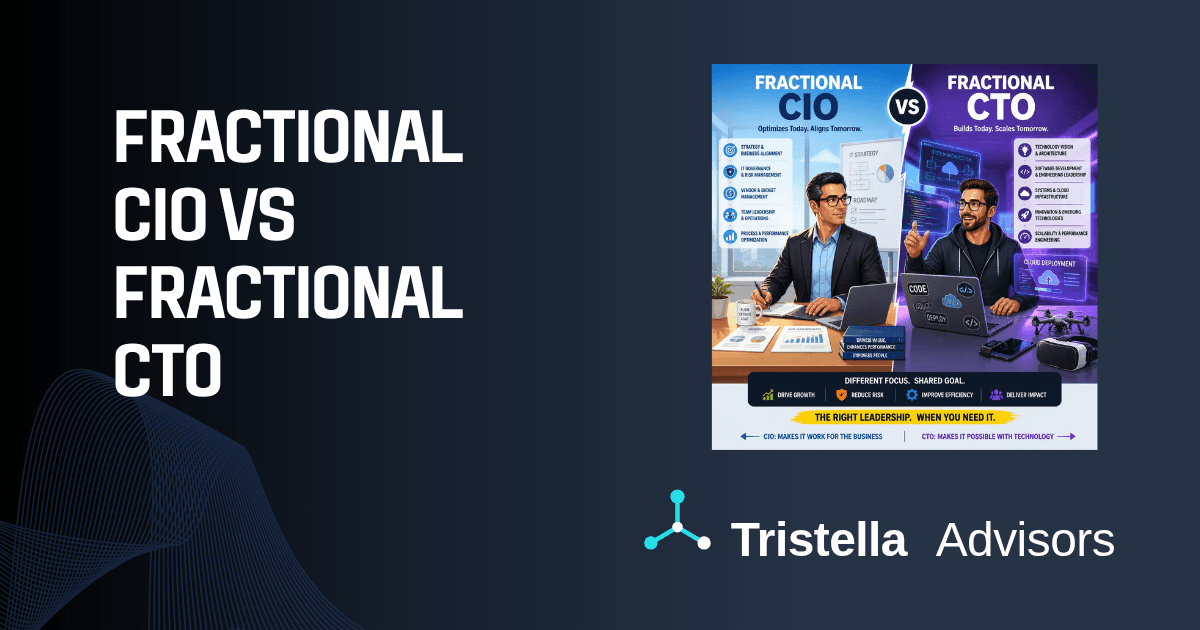
A fractional CIO optimizes and governs existing technology operations. A fractional CTO designs and builds new technology. For a funded startup that is building a product, those are not equivalent options at different price points. They are answers to different questions, and most early-stage companies have only one of those questions.
The confusion between the two roles costs founders real time and money. A company that hires a fractional CIO when it needs a fractional CTO ends up with a more organized Slack workspace and a polished vendor management process while the core engineering decisions that will shape the product for years go unmade. The reverse is rarer but happens: a company at real operational scale that hires a fractional CTO when its IT infrastructure is the actual problem. Both mismatches are avoidable.
The fundamental difference: build vs. run
The CTO owns how technology gets built. The CIO owns how technology gets run.
This distinction predates the titles and cuts across every other difference between the roles. A CTO is fundamentally answering the question: what should we build, and how? That means product architecture, engineering team structure, technical debt decisions, build-versus-buy choices, AI toolchain selection, developer productivity, and the multi-year technology roadmap that gives the product a direction. The CTO is oriented toward what the product can become.
A CIO is fundamentally answering the question: how do we keep what we have running reliably, securely, and cost-effectively? That means IT infrastructure, internal systems reliability, vendor contract management, endpoint security, network operations, ERP and HR system ownership, help desk, and the IT governance programs that satisfy auditors and compliance requirements. The CIO is oriented toward what the organization already has.
Neither role is more important in the abstract. In a 50,000-employee enterprise with mission-critical legacy systems, a complex multi-cloud infrastructure, and dozens of software vendor relationships, the CIO function is enormously valuable and enormously complex. In a Series A startup with fifteen engineers and a product that does not exist yet, the CIO function barely has a job to do.
What a CIO actually does, and why startups rarely need one
The full-time CIO at a mature organization manages a substantial operational footprint: multi-site network infrastructure, device management for hundreds or thousands of endpoints, internal application ownership (the ERP, the HRIS, the finance systems), a help desk organization, enterprise software vendor relationships, and the security governance program that keeps the organization compliant with SOC 2, ISO 27001, or whatever frameworks the company's customers and auditors require.
A fractional CIO is typically brought in when that operational footprint exists, but the organization cannot justify or recruit a full-time CIO. Common triggers: a post-merger IT integration, a SOC 2 Type II audit that exposed gaps in IT governance, IT costs that have grown without proportional value, or a period of rapid headcount growth that has outrun the IT function's ability to support the organization.
Notice what these triggers have in common: they all involve existing complexity. The fractional CIO's value is in bringing order and strategy to an IT function that has already developed substantial operational mass.
At seed or Series A, most product-building startups do not have that mass. Their internal IT is typically a Google Workspace or Microsoft 365 account, some SaaS tools (Notion, Slack, Figma, Linear), a few company-issued laptops managed through a lightweight MDM tool, and a security setup that amounts to enforcing MFA and running a vulnerability scanner on the few things the company has built. A fractional CIO would spend the majority of their time on problems that do not exist yet.
The IT question a seed-stage startup actually faces is not "how do we govern our existing technology operations." It is "what technology should we be building, and who should build it."
What a CTO actually does, and why product-building startups almost always need one
The fractional CTO's mandate at a product-building startup is to provide the senior technical judgment that the company needs to avoid expensive mistakes before they get baked into the architecture.
In practice, that means decisions like: what technology stack to build on, and why that choice creates or closes optionality two years from now. How to structure the data layer so the company can actually query its own data when it needs to. Whether to build authentication in-house or use a managed identity provider. How to architect the multi-tenant model before the first enterprise customer signs, not after. When to use a managed AI service versus building a custom solution, and what the switching costs are. How to design APIs that can be extended without rewriting the core system.
These are not decisions that can be delegated to the first engineer you hire. They are not decisions that a CIO, however talented, has the background to make well if their career has been in IT operations rather than software engineering. They are not decisions that a non-technical founder should be making unguided. They are exactly the decisions a fractional CTO with relevant product-building experience is structured to answer.
Beyond the architecture decisions, the fractional CTO covers the engineering team dimension: defining the roles the company actually needs to hire, screening candidates, setting the engineering culture and practices that will shape how the team works for years, and providing the senior technical leadership that attracts strong engineering hires who might not join a startup without credible technical leadership already in place.
For more on what this looks like week to week, see What Does a Fractional CTO Actually Do Week to Week?
The diagnostic: which gap do you actually have?
The right question is not "do I need a fractional CIO or fractional CTO." The right question is: What is the actual problem facing my company right now?
You have a CTO problem if:
You are a non-technical founder with funding and a product to build, and no one on your team has senior experience making the architecture and engineering decisions that are in front of you. The most common version of this is: you raised seed or Series A, you need to build quickly and correctly, and you are either flying blind on technical decisions or relying entirely on your first engineering hire, who is talented but junior.
You have a CTO departure and need continuity while you run a full search. The interim fractional CTO keeps the engineering organization functional, makes the architecture decisions that cannot wait, and supports the search for a permanent hire. For more on when each model makes sense, see Fractional CTO vs. Full-Time CTO: When Each Model Makes Sense.
You are scaling your engineering team from two to twenty people and the technical practices, architecture, and team structure that worked at two will not hold at twenty without intentional design.
You are preparing for technical due diligence by a Series B investor and need your architecture and engineering governance to be in a state that withstands serious scrutiny.
You have a CIO problem if:
You have a real internal IT footprint: 100 or more employees across multiple locations, a significant number of company-managed devices, internal systems with real operational complexity, and IT costs that have grown faster than their value. The IT function needs strategic leadership, not just management.
You are undergoing a merger or acquisition and need to integrate IT systems, rationalize vendor contracts, and establish a unified IT governance model across two organizations with different standards.
You are facing a serious compliance requirement: a SOC 2 Type II audit with significant findings, an enterprise customer whose security team has delivered a long list of requirements your IT controls do not currently satisfy, or an industry-specific regulatory framework your IT organization is not ready to meet.
You are not building technology as your product. A law firm, a professional services company, a manufacturer: these organizations use technology but do not build it. Their senior technology leadership needs are CIO-shaped, not CTO-shaped.
The cleaner framing: if technology is your product, you need a CTO. If technology is the infrastructure that supports your business, you probably need a CIO. Most funded software startups are in the first category.
The startup where a fractional CIO makes sense
There is a startup profile where the fractional CIO is the right answer, and it is worth describing it precisely so founders who fit that profile do not get talked into the wrong role.
You have a working product and an engineering team that functions well under the existing technical leadership. The engineering question is solved. The problem is that your internal IT has grown disorganized as headcount has scaled: devices are not consistently managed, your SaaS stack has proliferated without governance, you have a SOC 2 audit coming that will require formal IT controls you do not have, and the founder is spending meaningful time on IT vendor management because no one owns it. This is a real CIO problem.
Similarly: if you have completed an acquisition and are trying to integrate the acquired company's IT environment with your own, that is a CIO engagement, not a CTO engagement, unless the integration is at the product level rather than the infrastructure level.
The key signal is whether the gap is in building (CTO) or in running (CIO). If you are not sure which gap you have, the answer is almost always building. Companies that have not yet shipped a working product have a CTO gap. Companies that have an engineering team but not the IT governance to support 150 employees may have a CIO gap alongside the CTO work that is already covered.
Cost comparison
Fractional CTO and fractional CIO engagements run at comparable rates when scoped similarly, because both are senior executive resources priced on time and specialization.
A fractional CTO engagement at 10 to 20 hours per week typically runs $10,000 to $25,000 per month, or $120,000 to $300,000 annually. Domain specialization commands a premium: AI architecture, healthcare, financial services, and other regulated or specialized domains carry rates toward the top of that range because the learning curve is shorter and the guidance quality is higher.
Fractional CIO engagements are structured similarly, often running $8,000 to $18,000 per month depending on the scope and complexity of the IT environment being managed. The full-time CIO at a mature organization commands $244,000 to $425,000 per year in total compensation, per Glassdoor's 2026 data, making the fractional model similarly cost-efficient relative to the full-time alternative.
Neither role is cheap. The reason to choose one over the other is not cost. It is fit. The fractional model for either role provides value only if the role matches the problem at hand. A cheaper engagement in the wrong role is not a bargain.
For a detailed breakdown of fractional CTO pricing by scope and stage, see How Much Does a Fractional CTO Cost?
The category error to watch for
There is one scenario in which the CIO-versus-CTO confusion causes the most damage, and it is common enough to name explicitly.
A non-technical founder is advised to hire a "technology executive" and begins evaluating candidates. Some of those candidates have CTO backgrounds. Some have backgrounds in CIO or IT leadership. Without a clear picture of what the role is actually supposed to do, the evaluation process conflates them. The company ends up hiring someone whose career was in IT operations and vendor management because they interviewed well and seemed authoritative about technology.
That person arrives and quickly gets oriented toward the problems their background trained them to solve: organizing the SaaS stack, improving device management, building out IT governance documentation. The engineering architecture decisions, the tech stack choices, the product technical roadmap: they approach those with less depth than a CTO would bring, because those decisions are not where their pattern recognition is.
The company loses six to twelve months of senior technical guidance on exactly the decisions that were supposed to be the reason for the hire.
The fix is to be specific about the job before you evaluate candidates. Write down the three most important decisions the person you hire will need to make in the first 90 days. If those decisions are about internal IT management, security governance, or vendor contracts, you need a CIO background. If those decisions are about product architecture, engineering team structure, technical debt, or AI toolchain, you need a CTO background.
Where Tristella fits
Tristella Advisors' fractional CTO practice is built for funded, product-building companies that need senior technical judgment without a full-time hire: seed and Series A companies building their first engineering team, founders navigating the architecture decisions that will define the product's technical foundation, and organizations that need to build a governance and AI strategy alongside the engineering work.
We are not the right engagement for organizations whose primary need is IT operations management, internal systems governance, or device and network administration. For those needs, a fractional CIO or an IT director is the right answer. We say this so clearly because the wrong engagement wastes time and money that a startup cannot afford.
If you are a funded founder trying to figure out which gap you actually have, the most efficient starting point is a direct conversation rather than an extended evaluation process. We can usually identify within a single call whether the problem in front of you is a CTO problem, a VP of Engineering problem, a CIO problem, or something else. See Signs You Need a Fractional CTO for a structured way to diagnose the gap before that conversation.
Learn more about Tristella's fractional CTO engagements at tristellaadvisors.com/services/fractional-cto, or start with the What Is a Fractional CTO? guide if you are still building your mental model of what the role provides.
Related reading:
Sources: