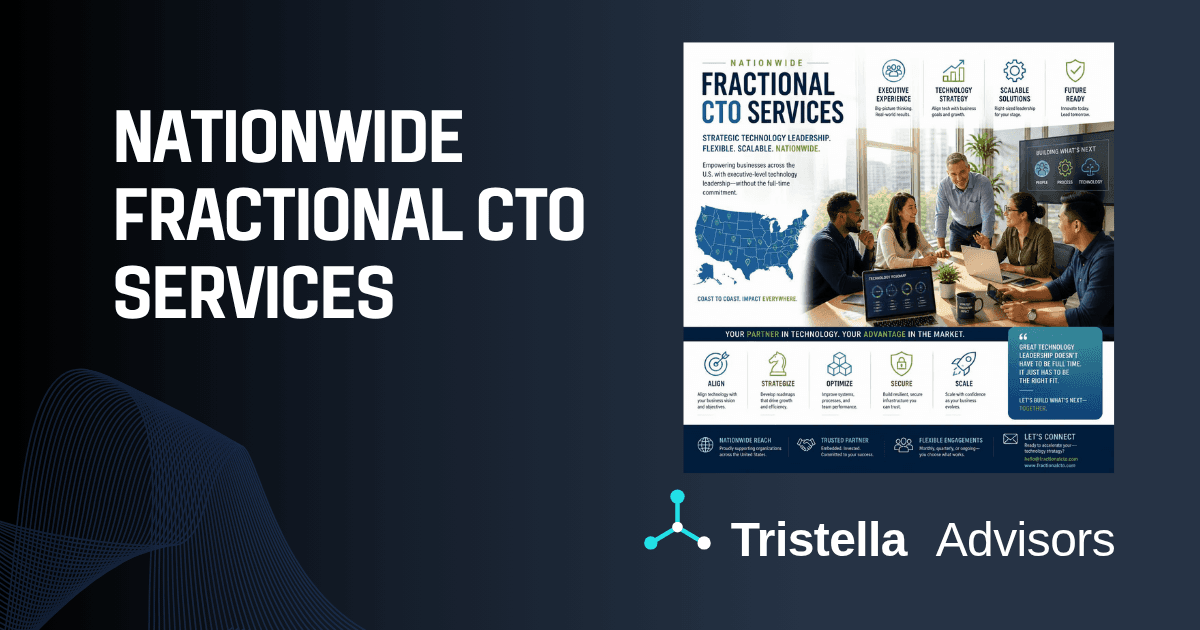
Tristella Advisors is based in Maine and Pennsylvania. Our advisors have worked for clients in New York, California, Washington, DC, and Seattle. That is not a contradiction. It is the premise this post is built on: that the most important things a fractional CTO brings to a company have nothing to do with where they park their car.
The search queries that land founders on this page, "fractional CTO New York," "fractional CTO DC," "fractional CTO firms California," all reflect the same instinct: find someone local because local means accessible. That instinct is understandable and mostly wrong. What determines whether a fractional CTO engagement works is domain expertise in your sector, time zone compatibility for real-time collaboration, and in-person availability when it's actually required. City of residence is a constraint on the third factor, not the first two.
This post covers how remote fractional CTO engagements operate, what makes each major startup market distinctive, how to evaluate fractional CTO companies and consulting firms before you hire one, and why founders in major tech markets consistently choose remote practitioners over local ones.
How a remote fractional CTO engagement actually works
The working structure of a fractional CTO engagement is more defined than most founders expect. It is not a loose advisory relationship where the fractional CTO dials in occasionally. It is a cadenced operating model that produces real institutional knowledge over time. That cadence is what makes the model work regardless of geography.
The weekly decision session. A 30- to 60-minute call focused on the technical decisions that require senior judgment this week: an architecture choice, a vendor evaluation, a hiring rubric, a security concern raised by a prospective enterprise customer. The fractional CTO is not there to be briefed. They are there to engage the decisions with pattern recognition from prior engagements. This session is fully remote by design because it is a thinking conversation, not a build session.
Async availability between sessions. A shared Slack channel or equivalent gives the founder and engineering team a place to drop questions, share context, and flag issues that need a senior read. Quick questions get answered the same day without a calendar invite. The time constraint of a fractional engagement creates a useful discipline: what actually gets asked is what actually matters.
The monthly strategic review. A longer session, typically 90 minutes, that steps back from the week's decisions to review the technical roadmap, team structure, and the trajectory of the technical foundation relative to where the company is headed over the next six to twelve months. This is where the fractional CTO connects the immediate decisions to the longer arc.
Beyond this cadence, effective fractional CTOs produce documentation, including architecture decision records, technical roadmaps, hiring rubrics, vendor evaluation frameworks, and board-ready technology summaries. This is how institutional knowledge gets built in a part-time engagement and how the company retains that knowledge when the engagement eventually transitions out.
In-person time is part of most engagements, but it is selective. Board meetings, fundraising preparation sessions, quarterly planning, and specific high-stakes conversations benefit from being in the room. For engagements within the same time zone region, that in-person allocation is typically one to two days per month. For cross-region engagements, it focuses on the moments that matter: quarterly, anchored in events that require physical presence.
The practical implication: a fractional CTO based in Maine can run an effective engagement with a New York or DC founder if the time zone is the same and the quarterly in-person commitment covers board meetings and planning cycles. They usually can, and they usually do.
New York: fintech, healthtech, and the enterprise credibility requirement
New York is the second-largest startup ecosystem in the United States by venture funding. New York startups raised more than $3.1 billion in 2025, with fintech accounting for 48.5% of all national fintech investment and healthtech representing 23.4% of national healthtech investment. Those two verticals define most of what a fractional CTO in New York does.
Fintech companies in New York need fractional CTOs with experience in regulated financial systems: API integration with banking infrastructure, the compliance architecture that enterprise financial buyers require, and the security posture that SOC 2 and financial-grade procurement reviews demand. Healthtech companies need fractional CTOs who understand clinical data models, HIPAA-compliant AI configuration, and the procurement process inside hospital systems and payers.
The other defining pattern in New York is B2B enterprise sales. New York startups selling into financial services, insurance, media, and healthcare enterprises face a specific technical due diligence process in which the fractional CTO's primary value lies in engineering management. It is technical credibility in front of the people making the buying decision, and the governance documentation that enterprise security reviews require before a contract can be signed.
A fractional CTO who has done this before, who has been in a room with an enterprise security committee and answered the questions they ask, is worth more to a New York B2B founder than a local generalist who has not. That expertise does not require a New York area code.
California: the Bay Area AI ecosystem and what it demands
The San Francisco Bay Area claimed 41.3% of all U.S. startup venture dollars raised in 2025, and its position in AI is even more dominant: 53.4% of all AI funding nationally went to Bay Area companies. OpenAI, Anthropic, Scale AI, and Databricks operate their flagship engineering out of San Francisco, creating a talent concentration and expectation set that shapes every startup in the region.
The practical consequence for fractional CTO demand: nearly every Bay Area founder is rethinking their product roadmap to include AI as a core capability. The fractional CTO need in this market is increasingly specific: someone who can evaluate AI architecture decisions critically, design governance frameworks for AI-enabled products, and assess whether a company's data infrastructure actually supports the AI features its roadmap assumes. That is a specialist capability, not a generalist one.
The Bay Area also runs at a higher velocity than most other markets. Funding rounds close faster, hiring decisions are made against a more competitive talent pool, and the pressure to ship is more intense. Fractional CTO engagements in California tend to be more embedded than advisory engagements, with the fractional CTO actively participating in architectural decisions and engineering hiring rather than serving as a periodic sounding board.
For California founders outside the Bay Area, Los Angeles has developed a substantial ecosystem in media tech, e-commerce, and consumer AI. San Diego's life sciences and biotech concentration creates fractional CTO demand similar to Boston's: regulated-environment experience, clinical data familiarity, and the FDA SaMD awareness that healthtech companies in that market need.
The Pacific-to-Eastern time zone gap is real but manageable for East Coast-based fractional CTOs. A four-to-five-hour overlap covers the decision session and most async questions. The engagements that work well across this gap are ones where the async documentation discipline is strong, because real-time collaboration is more constrained than it would be within the same timezone.
Washington, DC: govtech, federal IT, and the compliance-first engineering culture
The Washington, DC metro, covering DC proper, Northern Virginia, and Maryland, is the largest govtech and federal IT corridor in the world. The engineering ecosystem here is shaped by anchor institutions that do not exist elsewhere: AWS GovCloud, Microsoft's federal arm, Palantir's federal practice, Booz Allen Hamilton, the National Institutes of Health in Bethesda, and the concentration of large insurers in Northern Virginia.
The consequence for startups operating in or selling into this ecosystem is that compliance is not a feature. It is an entry requirement. FedRAMP-Moderate or FedRAMP-High posture, FISMA compliance, and StateRAMP readiness are baseline expectations for companies selling to federal or state government buyers, not premium add-ons that come later. A DC startup planning to pursue federal contracts needs a technical architecture that can withstand the System Security Plan process before it gets very far in the procurement.
This shapes what a fractional CTO engagement looks like in DC. The architecture work is heavier on compliance design than in most other markets. The vendor stack decisions are constrained by FedRAMP-authorized options. Hiring considerations include cleared engineering resources, which add a cost and timeline premium to the talent strategy. And the sales cycle, typically 12 to 24 months for federal and state government buyers, means a startup's technical roadmap needs to be planned against a longer revenue timeline than a typical SaaS engagement.
The NIH and the broader Bethesda biomedical corridor add a healthtech layer distinct from the healthtech ecosystems in New York or San Francisco. DC-area healthtech companies are often closer to the federal payer side, the regulatory side, and the major insurer buyers in NoVA than to the clinical delivery side that dominates New York healthtech. That buyer context is different and affects the technical architecture, the compliance requirements, and the procurement process.
Cybersecurity software is the other dominant vertical in the DC metro, shaped by decades of intelligence community talent and the presence of major defense contractors. Companies building security products here benefit from proximity to the world's most sophisticated government security buyers and from a talent pipeline with clearance experience. A fractional CTO who has built and shipped in that context understands the security architecture expectations and the buyer's evaluation criteria in ways that a generalist does not.
For a DC-area startup, the fractional CTO's value is not primarily about code review or team scaling. It is about building a technical foundation that survives federal procurement review, designing architecture that can be FedRAMP-authorized when the time comes, and credibly representing the company's technical posture to government buyers and compliance auditors who will pressure-test it.
Washington state: Seattle's enterprise infrastructure and AI concentration
Seattle's startup ecosystem was built on a different foundation than New York or San Francisco. Greater Seattle AI startups received substantial investment in 2025 and the region hosts multiple unicorns, with technical talent shaped by decades of proximity to Microsoft, Amazon, and Boeing. The companies that come out of Seattle tend to be strong at infrastructure, enterprise software, and systems-level thinking.
Seattle placed third nationally for SaaS funding in 2025, a position that reflects the Microsoft and Amazon ecosystems that define the region's technical culture. Companies selling into enterprise buyers in logistics, healthcare, aerospace, and financial services run longer sales cycles than typical SaaS norms, and the fractional CTO need in Seattle reflects that: technical leaders with enterprise architecture depth, comfort with the Microsoft and AWS ecosystems, and the ability to work within procurement processes that move at enterprise speed.
Seattle's connection to Microsoft makes it a meaningful market for Salesforce and Agentforce expertise. Companies integrating AI agents into Salesforce environments, particularly those with Health Cloud or Financial Services Cloud deployments, benefit from a fractional CTO who has worked in those specific technical contexts alongside Microsoft stack architecture.
How to evaluate fractional CTO companies and consulting firms
The search for a fractional CTO firm produces a landscape that is harder to evaluate than it looks. There are boutique firms, talent marketplaces, independent operators, and advisory firms all competing for the same search queries. The categories differ in important ways, and the right choice depends on what you are buying.
Boutique fractional CTO firms are the dominant model for sub-Series-B startups. A boutique firm presents a unified practice with a defined methodology, consistent partner involvement, and a track record with multiple clients across specific verticals. The principal-level practitioner is typically doing the work, not delegating to associates. The tradeoff is bench depth: a boutique firm cannot staff a global multi-workstream engagement the way a large advisory firm can.
Talent marketplaces match you with individual operators rather than a firm. You are hiring a person, not a practice. The quality varies by operator, the evaluation discipline falls on you, and the continuity risk is higher: if the operator takes a full-time role or leaves the engagement, the institutional knowledge walks with them.
Large advisory firms (Deloitte, Accenture, McKinsey, PwC) offer fractional and interim CTO coverage as part of broader executive services. The brand matters in some contexts, particularly for board-level credibility and regulatory filings. The trade-offs are cost, timeline, and staffing model: large-firm engagements typically start at $500K and run for months before the first deliverable, with day-to-day work often done by associate-level staff rather than the partner who sold the engagement.
Before choosing a firm or practitioner, five questions cut through most of the evaluation noise:
1. Who is doing the work? At a boutique firm, the answer should be: the same person you met in the sales conversation. Ask directly. If the answer is "a team of senior consultants matched to your needs," ask who specifically and what their track record is.
2. What vertical experience do they have, specifically? Generic experience does not transfer across regulated industries. A fractional CTO who has built healthcare AI products in HIPAA-compliant environments is a different practitioner from one who has primarily shipped B2C consumer apps, even if both use the title.
3. What does their track record actually show? Outcomes, not tenures. What did they build, change, or fix? Ask for references at companies similar to yours, at a similar stage, and call all of them.
4. What do they turn down? A firm that is honest about what it is not a good fit for is more credible than one that claims to serve everyone. The answer to this question tells you more about their self-awareness than any of the previous questions.
5. Can you run a 60-day pilot? Most boutique fractional CTO firms operate on month-to-month retainers with 30 days’ notice. If a firm requires a long-term commitment before you have seen the work, that is a risk worth naming before you sign.
The category that produces the most friction in this evaluation is the one founders skip most often: checking whether the fractional CTO's specific experience matches the specific problem. Domain expertise in your sector and stage matters more than any other single variable. A fractional CTO who has done your exact problem before, in your vertical, at your stage, is worth more than one who is local and available.
What actually determines fit
Tristella operates from Maine and Pennsylvania. Our clients are in New York, California, Washington DC, Seattle, and other markets across the country. The reason that works is not that we are exceptional at Zoom calls. It is that the factors that actually determine whether a fractional CTO engagement succeeds are not geographic.
Domain expertise in your sector. A fractional CTO who has built and shipped AI products in regulated environments, has been inside enterprise procurement processes and knows how to answer the security committee's questions, and has designed healthcare AI governance that survives a hospital IT review is more valuable to the right founder than any local generalist. The domain knowledge transfers across geography. Generic experience does not transfer even locally.
Timezone overlap for real-time collaboration. Four to five hours of overlap in working hours is the practical floor for an async-first engagement. Eastern to Pacific is workable. Engagements across significant timezone gaps require more structured async discipline to compensate.
In-person availability when it matters. The moments that require physical presence are usually quarterly: board meetings, fundraising preparation, strategic planning sessions, specific high-stakes conversations. A fractional CTO who can travel to those moments, even from another city, meets the in-person requirement without requiring local presence for every week of the engagement.
The cost comparison between fractional and full-time CTO models is consistent across all of these markets. In New York and San Francisco, where full-time CTO total compensation runs $600,000 and above at Series A companies, the fractional model at $8,000 to $25,000 per month represents 30 to 50% of the all-in cost of a full-time hire. The math does not change based on whether the fractional CTO is in your city.
Tristella Advisors serves founders across New York, California, Washington, DC, Washington State, and other markets through remote engagement structured around a defined cadence: weekly decision sessions, async availability, monthly strategic reviews, and selective in-person presence when required. Our fractional CTO practice is built around the same methodology regardless of geography: an assessment in the first weeks, a technical roadmap with real decisions documented, and a structured transition so that institutional knowledge stays with the company when the engagement ends.
Learn more about how we structure fractional CTO engagements at tristellaadvisors.com/services/fractional-cto, or start with our AI Production Readiness Assessment if AI architecture and governance are the specific problems you're facing.
Related reading:
How Much Does a Fractional CTO Cost, and When Does the Math Make Sense?
What to Look for in a Fractional CTO Firm: 7 Questions to Ask Before You Hire
What AI Governance Framework Do Venture-Backed Startups Need Before Launch?
What Enterprise Buyers Ask About AI Governance Before Signing a Contract
Sources:
Kompella Technologies: Best Fractional CTO Firms 2026: Honest Roundup
Fractionus: Fractional CTO: What They Do and When You Need One (2026)
Greater Seattle Economic Council: Seattle Startups Ecosystem and Funding
Crunchbase: Seed Funding Boom Concentrating in the San Francisco Bay Area
Site Selection Magazine: 2026 Global Startup Ecosystem Rankings