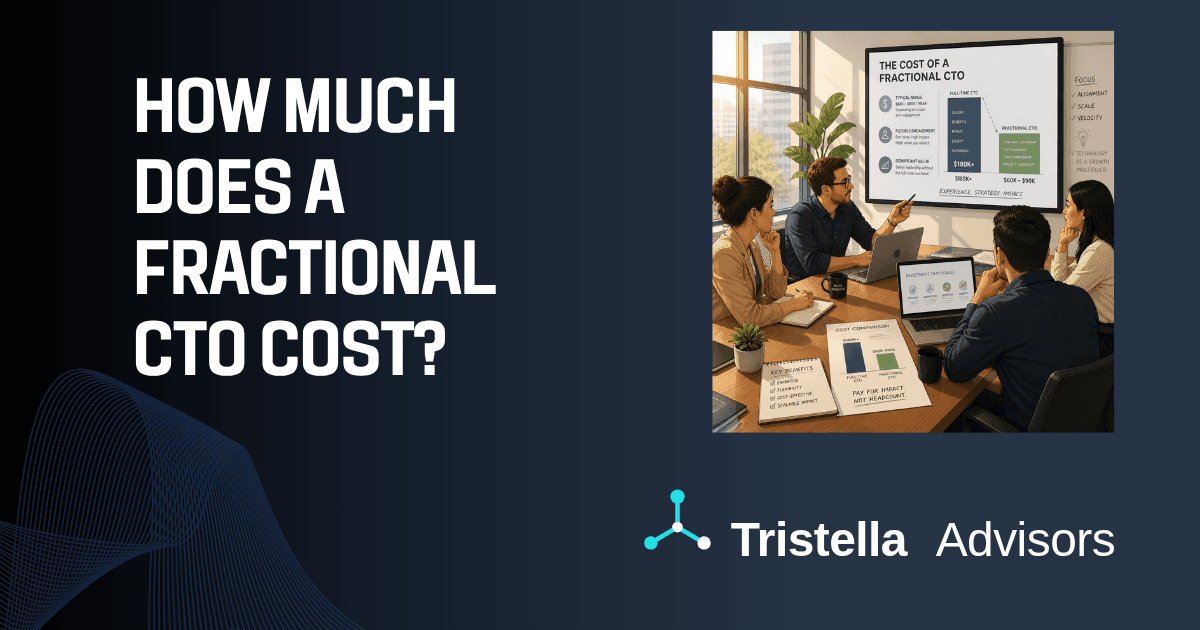
A fractional CTO retainer typically costs between $8,000 and $25,000 per month for 20 to 60 hours of embedded work. Hourly rates run $200 to $400 depending on the practitioner's background and engagement structure. Day rates for on-site or intensive work typically run $2,000 to $4,000.
What drives the difference is not just the person, it's the model. A talent marketplace that matches you with a contractor, a boutique advisory firm where a named partner does the work, and a solo consultant who juggles eight clients will each price differently and deliver differently. The rest of this post breaks down what you're actually buying at each price point.
Fractional CTO Monthly Retainer Cost
The most common engagement model is a monthly retainer with a defined hour band. Here's what the market looks like:
| Engagement type | Hours per month | Typical cost |
|---|---|---|
| Light advisory | 10 to 15 hours | $4,000 to $8,000 |
| Standard fractional engagement | 20 to 40 hours | $8,000 to $15,000 |
| Deep fractional (near full-time) | 40 to 60 hours | $15,000 to $25,000+ |
Tristella's retainers run $10,000 to $20,000 per month for 20 to 60 hours of embedded work. That includes weekly syncs, architecture reviews, hiring support, and board reporting as needed. See the fractional CTO services page for how engagements are structured.
The range is wide because the work is wide. A light advisory retainer means monthly calls and occasional document reviews. An embedded fractional engagement means the person is in your architecture decisions, hiring conversations, and investor updates. These are not the same product at different prices.
For a more detailed breakdown of how fractional CTO rates break down by engagement type, hourly, day rate, and retainer, including what drives variation at each tier, see our dedicated rates guide.
Fractional CTO Hourly Rate
Hourly fractional CTO rates typically run $200 to $400, with some practitioners going higher for specialized domains like AI governance, healthcare, or regulated industries.
A few things to know about hourly pricing:
Hourly rarely works better than retainer for ongoing engagements. The nature of CTO work requires context: your stack, your team, your investors, your history. A practitioner billing hourly who isn't fully in the picture is giving you their time, not their judgment.
Hourly makes sense for scoped work: a one-time architecture review, a specific vendor evaluation, a hiring panel for a senior engineering role. It is not the right model if you want an ongoing technology leadership partner.
If a firm quotes you a low hourly rate, ask what's included. A $150/hour fractional CTO who brings one junior associate and no senior time is not cheaper than a $300/hour practitioner who does the work themselves.
Fractional CTO Day Rate
Day rates for fractional CTO work run $2,000 to $4,000 for a full day on-site or in intensive project mode.
Day rates come up in specific situations: board meetings, offsites, architecture sprints, team assessments. They are not a substitute for an ongoing retainer, but they are a reasonable way to engage a practitioner for a bounded high-stakes session before committing to a longer relationship.
Some firms use day rates as the entry point to a larger engagement. A discovery or assessment day at $3,000 to $4,000 that produces a written technology assessment and recommendation is a low-risk way to test whether the fit is right before signing a multi-month retainer.
CTO-as-a-Service Cost
CTO-as-a-service is a term some vendors use for lightweight technology advisory, typically at lower price points than a full fractional CTO engagement. It usually means a subscription to access a CTO for a limited number of hours per month, often without the practitioner being embedded in the organization in any meaningful way.
Cost for CTO-as-a-service products runs from $2,000 to $6,000 per month.
The honest framing: CTO-as-a-service is a support product, not a leadership engagement. If your question is "I need someone to answer my technical questions," CTO-as-a-service may be sufficient. If your question is "I need someone accountable for technology decisions that determine whether my company succeeds," that is a different product and a different price point.
Fractional CTO Salary: Why This Search Is Misleading
A fractional CTO does not have a salary. They are not an employee. Searching for a "fractional CTO salary" is a reasonable starting point, but the comparison that actually matters is full-time CTO total compensation versus fractional CTO annual engagement cost.
A full-time CTO at a venture-backed startup typically costs $250,000 to $450,000 in total compensation (base, bonus, and equity valued at grant). That equity is not recoverable if the hire doesn't work out.
A fractional CTO engagement at $12,000 to $15,000 per month runs $144,000 to $180,000 annualized. No equity, no benefits overhead, immediate availability, and no six-month search process.
The break-even point where a full-time hire becomes more cost-effective depends on your stage and how much sustained technical leadership work you actually have. Most pre-Series A companies do not have enough to justify a full-time hire. Most post-Series A companies with more than 10 engineers do.
The decision between a fractional CTO vs a full-time hire comes down to stage, budget, and how much ongoing technical leadership the company actually needs.
What Drives Cost Up or Down
Several factors push fractional CTO cost higher or lower than the baseline range:
Experience in your specific domain. A practitioner with 30 years of engineering leadership who has built and governed AI systems in production charges more than someone who has held one CTO title at a single company. Specialized domain knowledge (healthcare, regulated industries, AI governance) commands a premium.
Engagement depth. Light advisory retainers with monthly check-ins are priced differently from engagements where the practitioner is in your Slack, your hiring decisions, and your board meetings.
Firm model. A talent marketplace takes a cut of the practitioner's rate. A boutique advisory firm charges the practitioner's rate directly but expects a higher floor. A solo practitioner may charge less but carries the risk of limited availability if their schedule changes.
Geography. Some practitioners charge more for travel or on-site requirements. Remote-first engagements tend to price more consistently.
Urgency. A fractional CTO engagement that starts in two weeks costs more than one that starts in six weeks. There is a limited supply of practitioners with the right experience, and timeline compression has a price.
How to Evaluate What You Are Paying For
Before signing any fractional CTO agreement, get answers to these:
Is the person you spoke with during the sales process the person who will do the work? Firms that pitch senior partners and deliver junior associates are not a value at any price. Ask explicitly and get it confirmed in writing.
What does the engagement actually include? A 20-hour retainer that counts email and Slack time differently from billable hours is not the same as a 20-hour retainer with a clear definition of what is included.
How many other clients are they running simultaneously? A practitioner running eight engagements is functionally unavailable when you need them. Ask. Good ones will tell you.
Can they give you a reference from a founder at your exact stage? Not a large company, not a post-IPO engagement. A founder who was pre-Series A when the engagement started and can speak to what the relationship looked like week to week.
If you're ready to talk specifics, the fractional CTO services page covers how Tristella's engagements are structured and priced.
Once you have a sense of budget, evaluating fractional CTO providers on specialization, engagement depth, and track record matters as much as the rate.