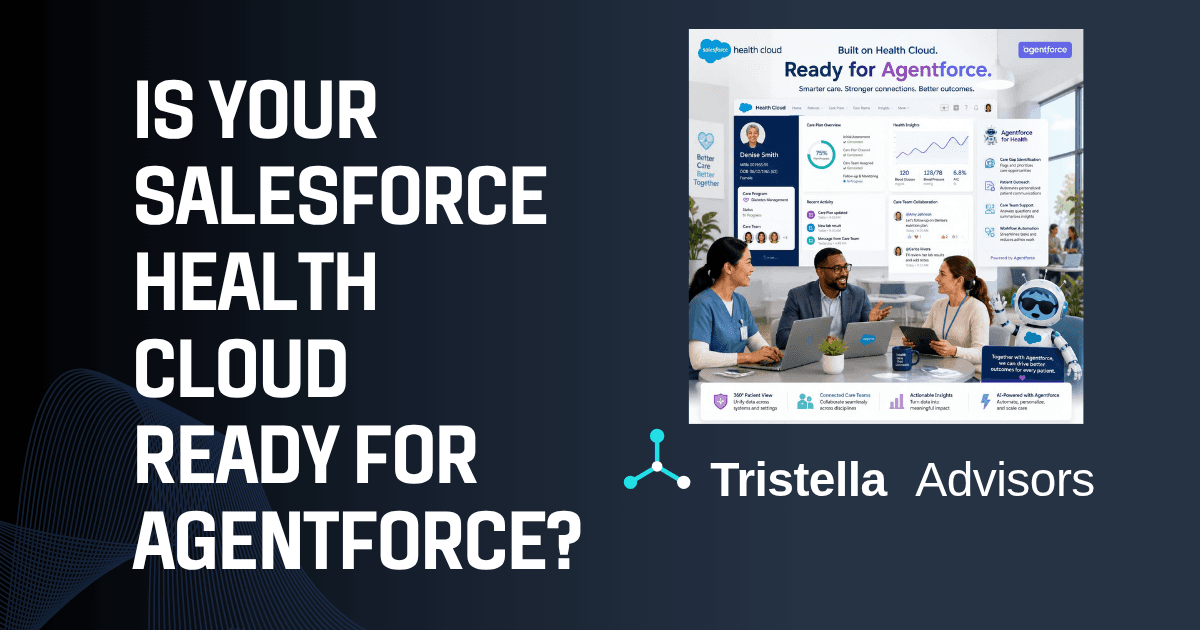
The demos are compelling. An AI agent that schedules patient appointments, verifies benefits in real time, and generates care coordinator summaries without a human touching the keyboard. If you're running a health system or a payor on Salesforce Health Cloud, Agentforce probably looks like the obvious next step.
What the demos don't show is the org configuration that has to exist before any of that works. And for Health Cloud specifically, that list is longer and more consequential than most implementation teams expect.
The organizations that move fast on Agentforce in healthcare are not the ones who start configuring agents immediately. They're the ones who look at their Health Cloud org first and ask the harder question: is what we've built actually ready to hand off to an AI?
Health Cloud is not standard Salesforce
This is the first thing most Agentforce readiness guides miss because most were written for standard Salesforce orgs.
Health Cloud runs on a different data model. Person Accounts instead of the standard Contact/Account relationship. Care Plans with their associated goals, problems, and tasks. Clinical data model objects for conditions, medications, care gaps, and assessments. EHR integration objects that sit between your Salesforce data and whatever is live in your Epic, Cerner, or athenahealth environment.
Agentforce agents are only as good as the data they can see and the logic they can follow. In a standard Salesforce org, the data model is relatively predictable. In Health Cloud, an agent configured without a deep understanding of how your specific org is structured will produce outputs that are incorrect, incomplete, or clinically irrelevant. The most common failure mode in Health Cloud Agentforce implementations isn't a technical configuration error. It's an agent that doesn't understand the clinical data model well enough to do anything useful with it.
If your Health Cloud implementation was done in phases, if Care Plans aren't fully configured, if your clinical data model objects aren't populated consistently, or if your Person Account model has exceptions that have accumulated over time, those gaps will surface the moment you put an AI agent on top of them. The agent will either fail visibly or produce confident-sounding outputs based on incomplete information, which is worse.
HIPAA compliance is not a switch you flip
This is the piece that stops more Agentforce healthcare projects than any other, and it almost never comes up in the initial scoping conversation.
Salesforce Agentforce can be configured to meet HIPAA requirements. It is not HIPAA-compliant by default. That distinction matters more than most implementation timelines account for.
The Einstein Trust Layer is the mechanism that enables HIPAA-compliant Agentforce. It handles PHI masking before data is sent to large language models, enforces zero-data retention with third-party AI providers, maintains audit trails of agent interactions, and respects your org's field-level security and sharing rules. But the Einstein Trust Layer only works if your data classification is set up correctly first.
Data Classification in Salesforce lets you tag fields as containing PHI, PII, or sensitive data. The Einstein Trust Layer reads those tags to determine what to mask. If your Health Cloud org hasn't gone through a rigorous data classification exercise, the Trust Layer doesn't know what to protect. Fields containing patient names, dates of birth, diagnoses, and insurance identifiers can flow to external LLMs without masking because nothing in the system told it they were sensitive.
Most Health Cloud orgs have never done a comprehensive data classification review because the compliance use case for it didn't exist until recently. That review needs to happen before an Agentforce project gets past the design phase. It is not a one-week task. For a complex Health Cloud org, it is a four- to six-week exercise, and it often surfaces field-level security gaps that must be resolved independently of anything Agentforce-related.
Beyond data classification, your permission model needs an agent-specific review. Salesforce's least-privilege model for Agentforce means defining exactly what data each agent can read, write, and act on. In a Health Cloud org with years of accumulated profiles and permission sets, that review is rarely clean. Permission model review is consistently the most overlooked step in Health Cloud Agentforce implementations, and it's the one that produces the compliance gaps that show up in audits later.
Your agents inherit your EHR integration quality
This is the dependency that surprises implementation teams focused on Salesforce configuration and who treat the EHR integration layer as a separate concern.
Agentforce agents operating on patient data in Health Cloud work with whatever data Health Cloud has. If your FHIR or HL7 integration with Epic, Cerner, or athenahealth is pulling data that is hours old, incomplete, or inconsistently mapped, your agents are working from that picture. An agent that generates a care coordinator summary or checks a patient's care gaps is only as accurate as the EHR data feeding it.
The EHR integration challenges in Health Cloud are well-documented: FHIR R4 mapping inconsistencies between source systems, authentication complexity with OAuth 2.0 across legacy EHR versions, bidirectional sync issues where updates in Salesforce need to flow back to the EHR without creating duplicates, and the latency problem that makes real-time use cases difficult when the integration was built for batch processing.
For each Agentforce use case you want to build, the question to ask is: what data does this agent need, where does that data actually live, how current is it when the agent accesses it, and what happens when it's wrong? A patient scheduling agent that books an appointment without knowing about a same-day admission creates a clinical problem. A benefits verification agent working from coverage data that hasn't been updated since the last weekly sync creates an operational problem. These aren't edge cases. They're the default behavior when EHR integration wasn't scoped with Agentforce in mind.
What's actually working in production
There are Health Cloud Agentforce use cases that are live and producing value. They share a common characteristic: they're built on workflows where the data is reliable, the process is well-defined, and the consequences of an agent error are visible and correctable.
Patient scheduling is the most mature. Salesforce's athenahealth integration for Agentforce supports appointment booking, rescheduling, and cancellation through a conversational interface. Organizations running this in production report significant reductions in scheduling call volume. The use case works because the scheduling data is up to date, the decision logic is explicit, and the agent is doing something that patients can immediately verify.
Benefits verification and prior authorization is showing consistent production results. The Availity integration for real-time prior authorization lets agents check coverage eligibility and submit authorization requests without a human having to manage the phone queue. For revenue cycle teams, this is a high-volume, high-error-rate process in which AI automation produces measurable cost reductions. It works because the data source is authoritative and updated in real time.
Care coordinator summaries are working in organizations where the Health Cloud data model is clean and the EHR integration is live. An agent that pulls together recent encounters, open care gaps, active care plan goals, and upcoming appointments into a pre-visit summary saves coordinators significant preparation time. The risk is data staleness: organizations running this successfully have usually completed a data quality initiative before deploying it.
Referral triage and discharge follow-up are in earlier stages of production deployment. The use cases are clear. The limiting factor in most orgs is the process documentation required to build reliable agent logic, not the Agentforce platform itself.
The readiness checklist most teams skip
Before any Agentforce configuration begins, a Health Cloud org needs to pass a set of readiness checks that go beyond what standard Agentforce guidance covers.
Data model audit. Are your Person Accounts configured consistently? Are Care Plans in use and populated in ways that reflect actual clinical workflows? Are your clinical data model objects mapped correctly to your source systems? An agent built on a Health Cloud org where Care Plans are populated inconsistently will produce inconsistent outputs.
Data classification review. Every field that an agent might access needs to be classified for PHI status. This drives the Einstein Trust Layer's masking logic. Without a complete classification, the Trust Layer cannot protect what it doesn't know is sensitive. This is the step that most orgs haven't done, and most vendors don't mention until someone asks about HIPAA.
EHR integration assessment. For each proposed Agentforce use case, map the data dependency back to its source. Is that data live or batch? How current is it when an agent accesses it? What happens to the agent's output if the integration is delayed or incomplete? The answers determine whether a use case is viable now or whether EHR integration work has to happen first.
Permission model review. Build agent permission sets from scratch using least-privilege principles. Don't copy existing user profiles. Agents should access only what they need for their specific function, and that scope should be explicitly defined and reviewed before go-live. In a mature Health Cloud org, this review often takes longer than the initial estimate because of accumulated permission complexity.
HIPAA configuration verification. Confirm Einstein Trust Layer activation, validate PHI masking is working correctly on test records, verify audit trail logging is enabled and accessible, and document the configuration as part of your BAA compliance record. This is not a check-the-box exercise. The documentation matters when the audit comes.
Implementation timelines for Agentforce in a Health Cloud environment range from 4 to 9 months for organizations that do this work properly. The timeline is rarely about the complexity of Agentforce configuration. It's about the readiness work that has to happen first, the data quality issues that surface during that work, and the EHR integration adjustments required to support the specific use cases on the roadmap.
The question before the question
The organizations that get Agentforce right in healthcare are the ones that treat the readiness assessment as the project rather than the prerequisite.
A standard Salesforce org can move from readiness to initial Agentforce deployment in weeks. A Health Cloud org with years of accumulated configuration, an EHR integration built before Agentforce existed, and a data model that reflects real clinical complexity needs a different starting point. The readiness work isn't a delay. It's what determines whether the deployment actually works when it goes live rather than producing outputs that erode clinical trust in AI before the project has a chance to prove itself.
Before you scope an Agentforce project, the right question is not "which agents do we want to build?" It's "what does our Health Cloud org actually look like right now, and what needs to be true before an agent can do anything useful with it?" Those are different projects, and conflating them is how healthcare AI investments end up in the same pilot purgatory as every other category of clinical technology that failed the people side before it got a fair technical evaluation.
This is also where the broader Agentforce readiness conversation and the security configuration decisions you made before Agentforce existed become directly relevant: the Health Cloud-specific concerns don't replace general Agentforce readiness requirements; they add to them.
If you're not sure where your org stands, our Salesforce Agentforce Readiness Assessment gives you an objective picture before you commit to a timeline or a vendor. And if you're already mid-implementation and running into the issues described here, the right conversation is about how to address the foundation without having to start over.
At Tristella Advisors, our Salesforce practice is built around exactly this gap: the space between a working Health Cloud org and one that's actually ready for AI agents. We've helped health systems and payors work through the readiness work that technology-focused implementations often overlook.
Learn more about how we approach Salesforce Agentforce engagements at tristellaadvisors.com/services/salesforce-agentforce.
Sources:
Accelirate: Agentforce for Healthcare: A Technical Implementation Guide
Torrent Consulting: EHR Integration Challenges in Health Cloud
Clear Concise Consulting: Data Readiness for Agentforce in Healthcare