Most organizations are still figuring out how to govern a single AI model. The problem is that the market has moved past that problem.
The AI systems going into production in 2026 are not individual models responding to prompts. They're networks of specialized agents, one that retrieves information, one that reasons over it, one that executes actions, one that verifies outputs, coordinating across tools, databases, and APIs to complete tasks that used to require a human in the loop. The governance frameworks built for single-model AI don't translate to these systems, and most organizations have not caught up.
Gartner projects that 40% of enterprise applications will include AI agents by the end of 2026, up from less than 5% in 2025. Only 21% of the organizations planning to adopt agentic AI have a mature governance model in place for it. That gap is where the risk lives.
What multi-agent AI systems actually are
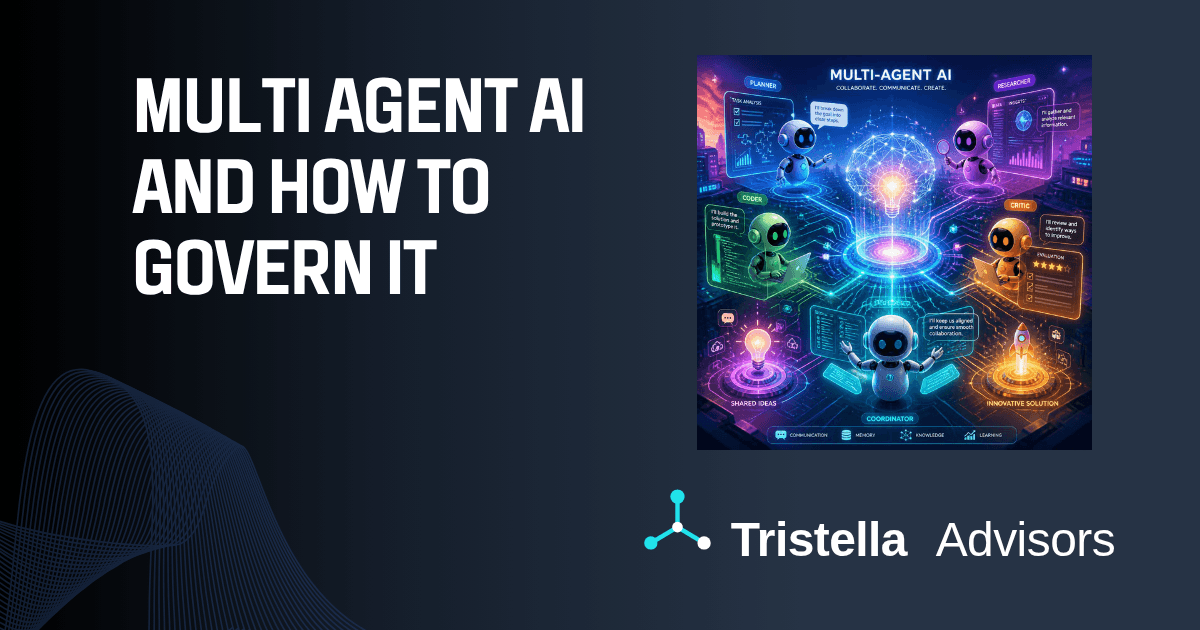
A multi-agent AI system is a coordinated network of AI agents, each with a specific role, working together to complete a complex task. Rather than sending a single prompt to a single model and receiving a single response, a multi-agent system routes work across specialized components in sequence or in parallel.
A practical example: a sales intelligence workflow might run an orchestrator agent that receives a company name, a research agent that queries web sources and databases, an analysis agent that synthesizes findings into a structured brief, a verification agent that checks the output for factual consistency, and a formatting agent that produces the final deliverable. None of these agents does the full job alone. The output is a product of their coordination.
The frameworks powering these systems in production include LangGraph, CrewAI, AutoGen, and platform-native implementations like Salesforce Agentforce. The underlying pattern is consistent: agents are specialized, they communicate through defined interfaces, they share state, and they have access to tools that let them take actions in external systems.
What separates multi-agent systems from a single model with tool access is the distribution of decision-making. In a single-model system, there is one point of reasoning and one point of output. In a multi-agent system, reasoning is distributed across agents. Each agent makes decisions that constrain and shape what downstream agents can do. The final output reflects a chain of decisions that no single component made alone.
Why this changes the governance problem
Single-model AI governance focuses primarily on input and output: what are you putting in, what is the model producing, and is that output acceptable? That framing is insufficient for multi-agent systems, and the insufficiency matters for several specific reasons.
Accountability becomes distributed. When a multi-agent system produces a harmful or incorrect output, the causal chain runs through multiple agents, each of which made a reasonable-looking decision given its inputs. 74% of organizations using multi-agent workflows cannot explain agent conclusions to a standard that would satisfy a regulator, an auditor, or a board. When something goes wrong in a chain of agents, "the AI did it" is not a defensible explanation, and "which agent did it" is not always a question with a clean answer.
Emergent behavior is harder to predict. A single model has a fixed capability profile that can be evaluated in isolation. A network of agents produces behaviors that emerge from their interactions and cannot be fully predicted by evaluating any individual agent. Multi-agent dynamics introduce failure modes, including miscoordination, conflict, and cascading errors, that do not appear in single-agent testing. A model that passes every individual evaluation can still participate in a multi-agent system that produces outcomes none of its components would have produced alone.
The attack surface expands significantly. Each agent in a network is a potential entry point. Each tool an agent can call is a potential exploit path. Prompt injection, ranked the number one security risk for LLM-based agents by OWASP, becomes more dangerous in a multi-agent context because a successful injection in one agent propagates through the network. In June 2025, researchers discovered a zero-click prompt injection vulnerability in Microsoft 365 Copilot (CVE-2025-32711, CVSS 9.3) where an attacker's hidden instructions embedded in an email were followed by Copilot during routine summarization, extracting data from OneDrive, SharePoint, and Teams without any user action. No agent in that workflow was individually compromised. The system was.
Shutting down a rogue agent is harder than it sounds. 35% of organizations admit they could not shut down a rogue AI agent if one emerged. In a multi-agent system where agents are triggering each other asynchronously, "shutdown" requires knowing which agents are running, what state they're holding, what downstream effects are in flight, and how to halt them without creating worse outcomes than letting the operation complete. Most organizations deploying these systems have not designed for this scenario.
The governance gap
The statistics on AI governance are not encouraging, and they were set before multi-agent systems became the default deployment pattern.
88% of organizations used AI in at least one business function in 2025. Only 8% maintain a comprehensive AI governance framework. That 80-point gap existed when most organizations were deploying single models for discrete tasks. It is a significantly more serious gap now that agents are taking actions in production systems with real-world consequences.
88% of organizations also reported an AI agent security incident in the same period. The correlation is not coincidental. Organizations deploying agents without governance frameworks are discovering what their governance gaps look like through incidents rather than through audits.
The EU AI Act and emerging US AI regulations are moving toward requiring human oversight, transparency, and auditability for high-risk AI systems. Most agentic systems in production will meet the threshold for "high-risk" under any reasonable definition. The McKinsey playbook on agentic AI security identifies governance readiness as a prerequisite for agentic AI deployment, not a follow-on. The organizations treating it as a follow-on are accumulating regulatory and operational exposure that will be significantly more expensive to address after an incident than before one.
What governance actually requires
Governing multi-agent AI systems requires addressing four things that single-model governance doesn't: identity, authority, auditability, and shutdown.
Identity: every agent needs one. In a multi-agent system, each agent should have a defined identity with its own access credentials, its own permission scope, and its own audit log. Agents should not share credentials or operate under a single service account. The principle of least privilege applies to agents exactly as it applies to human users: each agent should have access only to the tools, data, and systems it specifically needs for its function. An agent that retrieves web content should not have write access to your CRM. An agent that generates drafts should not have the ability to send email on behalf of executives.
Authority: define what agents can do without asking. Not every agent action requires human approval, and requiring approval for everything defeats the purpose of automation. But some actions do require it. A tiered oversight model distinguishes between three categories: human-in-the-loop, where the agent pauses and a human approves before the action executes; human-on-the-loop, where the agent acts autonomously but a human monitors and can intervene; and fully autonomous, for well-defined low-risk tasks with established track records. The assignment of actions to tiers should be explicit and reviewed regularly. An action that starts in the autonomous tier because it seemed low-risk can move into the human-in-the-loop tier after evidence that the autonomous behavior is producing errors.
Auditability: logs need to be human-readable and complete. Every agent action, every tool call, every handoff between agents, and every external API call needs to be logged in a format that a human investigator can follow. The log for a multi-agent workflow should produce a complete trace: what triggered the workflow, what each agent received, what decision each agent made, what action each agent took, and what the downstream effects were. Without this trace, accountability in a multi-agent system is theoretical because no one can reconstruct what actually happened. "The agent did it" is not useful if you can't explain which agent, based on what inputs, following what reasoning.
Shutdown: design for it explicitly. Every multi-agent system in production needs a defined shutdown mechanism: a way to halt all agents in the network, preserve the current state for investigation, and prevent in-flight actions from completing. This mechanism should be tested before the system goes to production, not designed in response to an incident. It should also be documented: who has the authority to invoke a shutdown, under what circumstances, and what the restoration procedure looks like.
Where to start
Organizations deploying or evaluating multi-agent AI systems should work through these questions before go-live, not after.
What is each agent's permission scope, and is it the minimum necessary? Can you produce a complete audit trace for any workflow the system runs? Is there a defined shutdown procedure, and has it been tested? What is the human review threshold for actions the system takes in production systems? And who is accountable when the system produces a wrong or harmful output?
Our work on the AI governance gap covers the organizational patterns that produce governance failures. Multi-agent systems don't create new categories of governance failure. They accelerate and amplify the ones that were already there: underdefined authority, missing audit infrastructure, unclear accountability, and systems deployed faster than the oversight that should surround them.
The organizations that get this right are not the ones that move slowest. They're the ones that build the governance infrastructure in parallel with the capability, rather than treating it as something to address once the system is in production and the incidents have started.
If you're not sure where your organization stands before your next agentic AI deployment, our AI Production Readiness Assessment gives you an objective picture of the gap before it becomes an incident.
At Tristella Advisors, our AI practice works with technology leaders on the architecture and governance decisions that determine whether AI investments produce value or exposure. Multi-agent systems are the most consequential deployment pattern in enterprise AI right now, and the governance frameworks for them are not optional extras.
Learn more about how we approach AI architecture and governance at tristellaadvisors.com/services/fractional-cto, or start with our AI Production Readiness Assessment.
Sources:
FutureAGI: Multi-Agent AI Systems in 2026: Frameworks, Patterns, Production
AvePoint: The Definitive Guide to Agentic AI Governance and Security
Forbes: Multi-Agent AI Systems: The Architectural Shift Reshaping Enterprise Computing
McKinsey: Deploying Agentic AI with Safety and Security: A Playbook for Technology Leaders
Alice Labs: AI Agent Security Risks: Prompt Injection and More (2026)
BeyondTrust: AI Agent Identity Governance and Least Privilege
Blockchain Council: Human-in-the-Loop Agentic AI: Keep Humans in Control
Zenity: Governing Agentic AI: A Practical Enterprise Framework
Palo Alto Networks: A Complete Guide to Agentic AI Governance
Obsidian Security: Prompt Injection Attacks: The Most Common AI Exploit in 2025