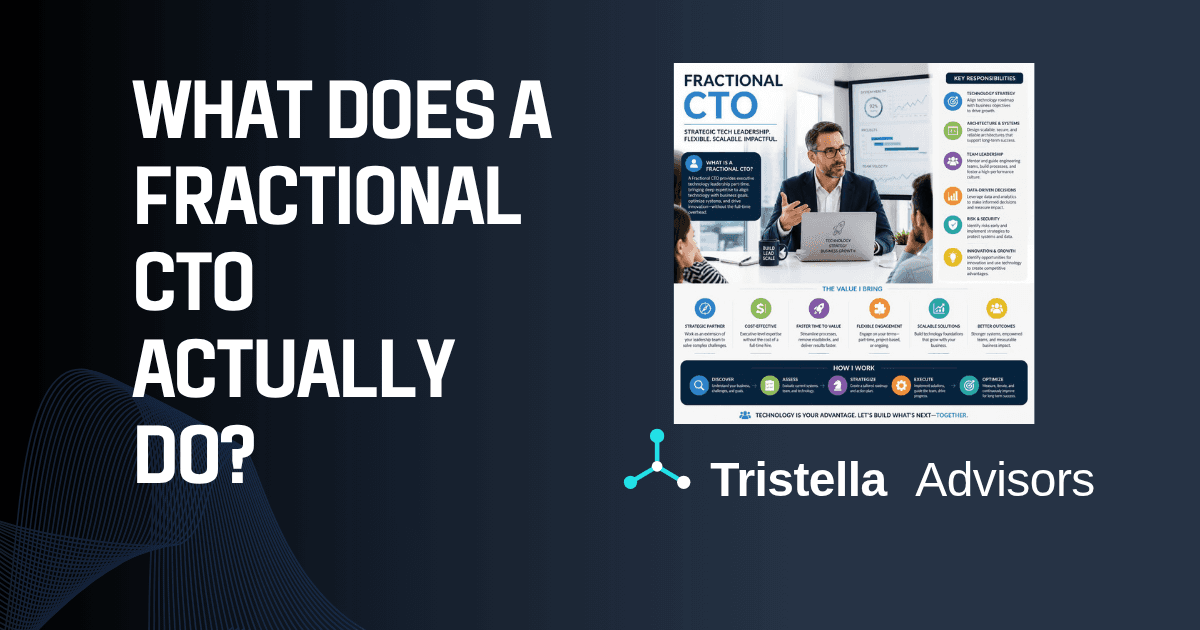
Most descriptions of fractional CTO services are frustratingly vague. "Strategic technology leadership." "Aligns technical and business goals." "Senior guidance on a flexible basis." If you're a non-technical founder trying to figure out whether this is the right investment, that language tells you almost nothing about what you're actually getting.
So let's be specific.
A fractional CTO works with your company roughly 10 to 20 hours per week, usually two to three days. What they do with that time depends on where you are as a company, but the categories are consistent. Here's what it actually looks like.
Week one: what you're really buying on day one
The first week is not strategy. It's assessment.
A fractional CTO coming into a new engagement will spend the first 10 to 15 hours mapping what you actually have versus what you think you have. That means reviewing your deployment pipeline, database schema, API contracts, test coverage, and the dependency chain of everything running in production. They'll talk to your engineers, if you have them, about what slows them down. They'll look at your roadmap and give you a clear-eyed assessment of whether your current architecture can actually build what's on it.
By the end of week one, a fractional CTO should have a working mental model of your technology landscape, an initial view of where your immediate risks and opportunities sit, and the questions that nobody has been asking. By week three, you should have a prioritized technical roadmap tied to your business goals. If you don't have that by day 30, something is wrong.
What you'll almost always find: the technical picture doesn't match the narrative. That's the point. You're buying a set of experienced eyes that don't accept the story you've been telling yourself about the codebase.
A typical week, broken down
Once the engagement is established, the time is allocated roughly as follows.
Architecture review and code decisions: 5 to 8 hours
A fractional CTO doesn't review every pull request. They review the ones that matter: the changes to database schemas, API surfaces, authentication flows, and data models. The architectural decisions that feel like technical choices but are, in fact, business decisions in disguise.
When someone proposes a significant change to an architecture-shaping component, a fractional CTO says: here's what this decision costs you in six months. You'll hear things like: "This approach works at 10,000 users. At 100,000, you'll hit this specific limit, and refactoring to get out of it will take six weeks. Building it the right way now costs three extra days." That kind of intervention saves months of technical debt remediation later, which McKinsey estimates consumes 25 to 50% of developer time in companies that don't manage it proactively.
Technical roadmap and sprint prioritization: 2 to 4 hours
Your engineers can build features. What they can't always do is sequence the work so it doesn't create bottlenecks three months from now. A fractional CTO helps you find the overlap: build the logging infrastructure while you're implementing authentication. Refactor the payment layer while the design team is working on the new dashboard. Technical and product work aren't sequential when a senior orchestrates them.
Vendor and technology decisions: 2 to 4 hours
Two to four times a month, you'll face a decision about tools, infrastructure, or vendors. A new database. Whether to migrate to a different cloud provider. Whether to bring in a logging solution or build one. Whether to use a framework the team wants to try or stick with what you know.
These decisions feel tactical, but they compound over time. A fractional CTO gives you the opinion that accounts for your stage, your team's actual skill set, and your runway. "Use the boring tool" is sometimes the right answer. "Invest in this because it unlocks the next three features" is sometimes the right answer. The point is that someone with pattern recognition across dozens of similar companies is making the call with you, not whoever happens to have the strongest opinion in the room.
Team and hiring: 2 to 4 hours
If you're hiring engineers, a fractional CTO writes the job descriptions that describe the role accurately, runs or participates in technical interviews, and can tell the difference between someone who understands systems thinking and someone who knows how to call APIs. That distinction is hard to make without technical depth, and getting it wrong is expensive.
As your team grows from two engineers to five to ten, a fractional CTO structures the team before it becomes a bottleneck. Establishes coding standards. Creates architectural decision records. Sets up a deployment checklist so that launches don't depend on a single person's availability.
Availability for production issues: variable
Most weeks, nothing breaks. But when something does, a fractional CTO has seen the pattern before. Database is slow before a major launch. Payment integration goes down twelve hours before an announcement. They help you triage: is this a twenty-minute fix or a six-hour incident? What do you communicate to customers and when? Their value in these moments isn't fixing the code. It's knowing how bad the problem actually is, which your team often can't assess without experience to compare against.
The investor and board dimension
This is the piece that doesn't make it into most descriptions of the role, and it matters a lot for non-technical founders.
A fractional CTO represents your technical side in conversations where your credibility depends on having one. They join investor calls and board meetings. They handle the technical portions of due diligence. When a potential enterprise customer asks about your security posture, your architecture documentation, or whether your system can handle ten times the current load, your fractional CTO is the person who answers credibly.
Series A technical due diligence is when this becomes critical. An investor's technical team reviews your architecture, codebase, team structure, and decisions regarding IP and security. A fractional CTO prepares your documentation, identifies the problems before the investor does, and sits in the room when the hard questions come up. You don't want to be learning about your technical vulnerabilities at the same time the investor is.
For non-technical founders, the single most valuable thing a fractional CTO does is translate technical reality into business decisions. Not "we should refactor the database." "The database structure we chose six months ago is going to cost us the enterprise deal we're pursuing, and here's what it takes to fix it before that conversation." That translation is what lets you make decisions confidently without needing to become technical yourself.
What a fractional CTO does not do
This is worth being direct about.
A fractional CTO does not write production code. They are not an additional engineer on your team. If you need more development output, hire engineers. If you need senior technical judgment directing the engineers you have, that's the fractional CTO role.
A fractional CTO does not manage day-to-day tickets or sprint logistics. That's an engineering manager function. In very early teams where that role doesn't exist, a fractional CTO might set up the process, but ongoing sprint management is not what they're there for.
A fractional CTO does not make business decisions for you. They give you the technical input you need to make those decisions. When you're choosing between two product directions with different technical implications, they tell you what each one actually costs. You decide.
And a fractional CTO is not a vendor. They're not protecting a title or managing up. They tell you the truth about your codebase because their value to you depends on it. A full-time CTO who has been with the company for two years has an incentive to present the technical picture charitably. A fractional CTO who shows up with 12 to 20 hours of focused attention per week has an incentive to tell you exactly what they see.
How engagements typically evolve
Most fractional CTO engagements at early-stage companies run three to twelve months. The early months are heavier on assessment and roadmap-building. Once the technical foundation is established and the team has some structure, the engagement often shifts to lighter, ongoing oversight: architecture review, hiring support, investor preparation, and availability when something important comes up.
The case for a full-time CTO gets stronger at Series B and beyond, when investors expect a committed C-suite and the company needs full-time technical leadership at the board level. A well-run fractional engagement sets you up for that transition: the architecture is documented, the team has standards, the hiring has been done thoughtfully, and the technical due diligence materials are ready. The fractional CTO has been building toward their own replacement, which is exactly what you want.
The question most founders are actually asking when they search for "what does a fractional CTO do" isn't about job descriptions. It's whether the investment produces something real. The answer is yes, if the timing is right and the engagement is structured correctly. You get the judgment of someone who has done this before, applied specifically to the decisions in front of you, without the six-month search, the equity, or the $400,000-plus all-in cost of a full-time hire. We covered the math on that in more detail in our post on fractional CTO costs and when the model makes sense.
At Tristella Advisors, fractional CTO engagements are built around exactly this: senior technical judgment, applied to the decisions that matter most at your stage, starting within days of an agreement. If you're trying to figure out whether this is the right model for where you are right now, the conversation starts there.
Learn more about how we work at tristellaadvisors.com/services/fractional-cto.
Sources:
Particle41: How Does a Fractional CTO Help You Prepare for Due Diligence?
Rational Partners: The First 30 Days of a Fractional CTO Engagement
Fractionus: Fractional CTO: What They Do and When You Need One (2026)
Kompella Technologies: What Is a Fractional CTO? The Definitive Guide for 2026
CTO Input: Fractional CTO Onboarding: 30-Day Plan for Leaders
AlgoCentric Digital: Fractional CTO for Early Stage Startups