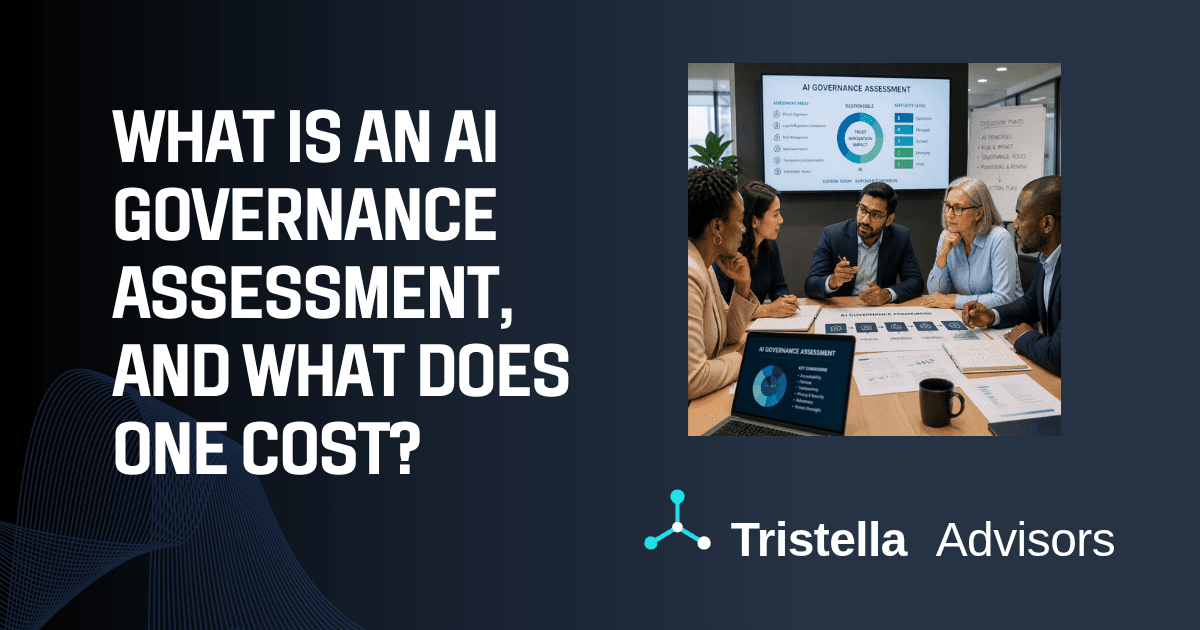
An AI governance assessment is a structured review of how an organization identifies, controls, and is accountable for its AI systems. A good assessment produces two things: a scored picture of where your governance posture stands today across the dimensions that matter, and a prioritized roadmap of what to fix first. The output is not a compliance certificate. It is a gap map with enough specificity to act on.
Whether you need one right now depends on a short list of conditions: whether your organization uses AI in decisions that affect customers, employees, or regulated data; whether investors, enterprise buyers, or regulators have started asking about your AI governance; and whether, if those questions came tomorrow, you could answer them with documentation rather than intention. If the honest answer to any of these is "not really," the assessment is not a future concern.
Why AI governance assessments have become a standard engagement
87% of organizations claim to have AI governance frameworks. Fewer than 25% have fully implemented the controls those frameworks describe. That gap between policy existence and policy implementation is what drove the demand for third-party assessments. You cannot close a gap you have not measured.
Grant Thornton's 2026 AI Impact Survey found that 78% of executives lack confidence they could pass an independent AI governance audit within 90 days. These are not organizations without governance documents. They are organizations whose governance documents describe controls that were never built into operational reality. The assessment is the process that identifies which controls exist in practice and which exist only on paper.
The proximate triggers for getting an assessment done tend to be one of four things. An enterprise sales process where the customer's security team sends a detailed AI governance questionnaire. A fundraise where an investor's technical due diligence includes questions about AI policy, accountability, and incident response. A regulatory inquiry or compliance review in a sector with active AI governance rules (e.g., healthcare, financial services, EU markets). Or a governance incident: an AI system producing harmful or unexpected output that suddenly makes the absence of a governance posture visible.
The best time to conduct an AI governance assessment is before any of those four triggers occurs. The second best time is immediately after.
What an AI governance assessment actually covers
AI governance is not a single dimension. The organizations that treat it as a compliance checklist tend to produce governance documents that fail their first real test, because a checklist tells you whether a policy exists, not whether it works. A maturity-based assessment covers six distinct areas of governance risk, each of which can be strong or weak independently of the others.
AI inventory and risk classification. The first and most foundational question: does your organization have a documented list of every AI system in use, what it does, what data it touches, and who owns it? Most organizations discover during this phase that they have significantly more AI in their stack than they formally track. Salesforce Einstein, GitHub Copilot, embedded AI features in support platforms, CRM AI tools, code review assistants: all of these are AI systems with data footprints and governance implications. You cannot govern what you have not named.
Governance accountability. Is there a named individual, not a team, who is accountable for your organization's AI risk? A named AI Responsible Party, an Acceptable Use Policy, and defined escalation paths for AI-related decisions and incidents. Governance that is owned by everyone is owned by no one. This dimension asks whether accountability is specific and documented.
Data practices for AI. Are the data inputs to your AI systems understood and controlled? This covers training data provenance, what customer or sensitive data flows through AI tools, whether Data Processing Agreements are in place with AI vendors, and whether privacy settings have been actively configured rather than left at defaults. One misconfigured AI tool sending protected data to a third-party model is enough to create a material compliance exposure.
Output quality and human oversight. Which AI outputs in your organization affect consequential decisions? Which of those have human review checkpoints and which are fully automated? This dimension assesses whether the organization has defined where humans stay in the loop and has built the monitoring infrastructure to detect when AI outputs drift from acceptable parameters. As AI systems move from advisory to agentic, this dimension carries the most operational risk.
Third-party AI risk. Most organizations' AI exposure is concentrated in the AI-enabled SaaS products they subscribe to, not in models they have built themselves. A mature governance posture requires a vendor inventory, a pre-adoption checklist, DPAs with all AI vendors processing personal data, and a regular review of vendor terms, which change frequently and often without prominent notice.
Incident response. What is your organization's documented response when an AI system produces a harmful output, exposes data it should not have touched, or contributes to a decision that goes wrong? This dimension assesses whether there is a written process, whether it has been tested, and whether the escalation paths and post-incident review requirements are defined.
A governance assessment scores each of these dimensions against a maturity model, typically on a 1-to-5 scale, with benchmarks by company stage and industry. The result is not a pass/fail grade. It is a profile: which dimensions are strong, which are weak, and where the gap between current posture and where you need to be is largest.
The AI governance maturity model, explained
The maturity model is the evaluation framework that makes an assessment meaningful rather than subjective. Without one, "your governance is weak" is an opinion. With one, "you are at Level 2 on accountability and Level 1 on incident response, against an industry median of Level 3 and an enterprise buyer expectation of Level 3" is an actionable finding.
A five-level maturity model for AI governance generally runs as follows:
Level 1 (Ad hoc): No formal policies. AI tools adopted without consistent review. No named accountability. Governance exists only as individual judgment, not a documented process.
Level 2 (Documented): A policy document is in place. An AI inventory has been started. Someone is nominally accountable for AI governance, though it is often a secondary responsibility. Controls are described but not consistently enforced.
Level 3 (Implemented): Policies are in practice, not just on paper. The AI inventory is maintained. Data handling rules are enforced with training. Human-in-the-loop checkpoints exist for high-risk decisions. The organization could answer a governance questionnaire with documentation.
Level 4 (Monitored): Governance is operational. Behavioral drift, permission scope, and output quality are monitored with defined thresholds. Access review happens on a defined cadence. Incident response has been tested. Governance gaps are identified and closed as part of regular operations.
Level 5 (Optimized): Governance is continuous and self-improving. Post-incident reviews produce specific governance changes. AI adoption decisions are governed upstream, not just reviewed after deployment. The governance posture is a competitive asset in enterprise sales and investor due diligence.
McKinsey's 2026 State of AI Trust research puts the average responsible AI maturity score at 2.3 out of 5 across organizations. Only one in three has reached the maturity adequate for the autonomous AI systems they are already running. Most organizations are at Level 2 when they need to be at Level 3 for enterprise buyers and Level 4 before they put agentic systems into production workflows.
What an AI governance assessment costs
The cost varies substantially based on the model. There are three categories worth distinguishing.
Enterprise governance frameworks (NIST AI RMF, ISO/IEC 42001). These are the right tools for large organizations with dedicated compliance teams and regulatory obligations that require certification. NIST AI RMF covers 72 subcategories across 19 categories. ISO/IEC 42001 implementation typically runs $15,000 to $80,000, with certification adding another $8,000 to $18,000. Engagement timelines are measured in months. For a Fortune 500 company with a complex AI portfolio and board-level governance requirements, this investment is proportionate. For a 40-person healthcare startup or a Series B SaaS company, it is not.
Large advisory firms (Big 4, major consulting firms). AI governance engagements from Deloitte, McKinsey, PwC, and Accenture typically start at $500,000 and take three to six months to produce the first deliverable. The model makes sense for organizations with the budget, the internal infrastructure to absorb a large engagement team, and the board-level audience that values a major firm's name on the cover page.
Scoped boutique assessments. For most organizations that need a real, structured assessment without the enterprise timeline or price tag, a scoped boutique engagement is the appropriate model. These engagements typically take two to four weeks, produce a scored gap report across all six governance dimensions, and deliver a prioritized remediation roadmap with specific owners and next steps. The cost of a scoped AI governance assessment ranges from $10,000 to $20,000. Advisory support to implement the remediation roadmap adds $15,000 to $40,000, depending on the scope and the number of dimensions requiring significant remediation.
The difference between a $10,000 scoped assessment and a $500,000 enterprise engagement is not primarily quality. It is scope, depth of multi-jurisdiction regulatory coverage, and the organizational size the engagement is designed to serve. A funded startup or mid-market company that needs to answer investor and enterprise buyer governance questions does not need six months and a partner-led team. It needs a two-week structured assessment that produces defensible, documented answers.
The Polaris AI Risk Assessment Framework
The Polaris AI Risk Assessment Framework is Tristella Advisors' structured approach to AI governance assessment for growing companies. It is designed specifically for the gap between "we're too small for ISO 42001" and "we need real governance infrastructure before our next enterprise sale or fundraise."
Polaris covers all six governance dimensions described above. For each pillar, it defines what good looks like at each maturity level, produces a score, and identifies the specific gaps most likely to surface in an investor due diligence process, an enterprise security questionnaire, or a regulatory inquiry.
The framework borrows the core logic from NIST AI RMF and ISO/IEC 42001 and strips out everything that requires a dedicated compliance team to operate. A technical lead can implement the control changes Polaris identifies in weeks, not quarters.
Download the Polaris AI Risk Assessment Framework to see the full six-pillar structure, the maturity definitions, and the implementation guidance for each dimension.
Where to start
The fastest way to understand where your organization stands is to take the AI Governance Gap Assessment, a free, scored quiz that covers the six Polaris dimensions. It takes under 10 minutes and produces a maturity score for each dimension, along with a personalized report identifying your highest-priority gaps. It is designed for CTOs, VPs of Engineering, and technical founders who want a calibrated starting point before deciding whether a full assessment engagement makes sense.
Tristella's AI governance assessment services include a scored maturity review across all six Polaris dimensions and a prioritized roadmap with named owners and sequenced next steps.
The natural progression from there:
Take the free AI Governance Gap Assessment at tristellaadvisors.com/ai-governance-gap-assessment to see your maturity score across all six dimensions and understand which gaps are highest priority.
Download the Polaris AI Risk Assessment Framework at tristellaadvisors.com/polaris for the full six-pillar framework, implementation guidance, and the maturity definitions your team can work against directly.
Book a call at tristellaadvisors.com/contact if you want a structured Polaris Assessment engagement: two to three weeks, a scored gap report across all six pillars, and a prioritized remediation roadmap with specific owners and timelines.
The goal is not a perfect governance posture on day one. It is enough visibility into your current posture to know what needs to be fixed before it surfaces as a problem in a sales cycle, a fundraise, or an incident. The assessment is what makes that visibility specific rather than general.
At Tristella Advisors, our AI governance practice works with funded startups, mid-market technology companies, and healthcare organizations that need governance infrastructure built to real standards, at the pace and price point that matches their stage.
Learn more about our approach to AI governance at tristellaadvisors.com/services/fractional-cto.
Related reading:
What AI Governance Framework Do Venture-Backed Startups Need Before Launch?
What Enterprise Buyers Ask About AI Governance Before Signing a Contract
Should I Hire a Boutique Firm or a Big 4 Firm for AI Governance Advisory?
Sources:
Journal of Accountancy: AI and Governance Issues — 3 Keys to Bridging a Costly Gap (April 2026)
Grant Thornton: 2026 AI Impact Survey — The Governance Proof Gap
McKinsey: State of AI Trust in 2026 — Shifting to the Agentic Era
Corporate Compliance Insights: AI Risk 2026 — Critical Changes for General Counsel
Elevate Consult: Proven Ways to Avoid AI Governance Penalties in Fintech