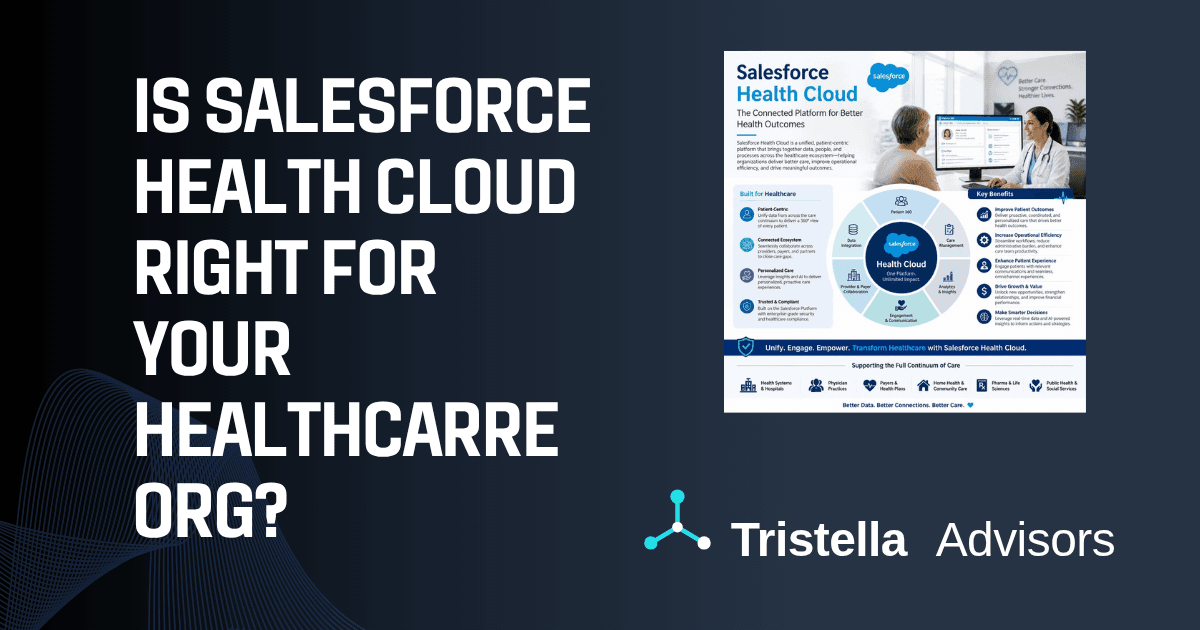
Salesforce Health Cloud comes up in a lot of conversations about healthcare digital transformation, often without a clear explanation of what it actually is, what it costs, and what kind of organization actually benefits from it. The result is a pattern that repeats across the industry: organizations commit to a Health Cloud implementation expecting a healthcare CRM and discover midway through that the platform is significantly more complex, more configurable, and more dependent on organizational readiness than they anticipated.
This post is the overview those organizations needed before they started.
What Salesforce Health Cloud actually is
Salesforce Health Cloud is a healthcare-specific platform built on top of the Salesforce CRM core. It's designed to unify patient and member data, support care coordination workflows, manage provider networks, and connect across the systems, EHRs, payer platforms, and operational tools, that healthcare organizations actually use.
The key word is "built on top of." Health Cloud is not a separate product from Salesforce. It's a layer of healthcare-specific data models, workflows, and compliance configurations sitting on the same platform used across financial services, manufacturing, and retail. That architecture is what makes it powerful: the full capability of the Salesforce platform, security model, automation tools, reporting engine, and AppExchange ecosystem, scoped to the specific requirements of healthcare organizations.
But it also means that Health Cloud is not Salesforce with a healthcare logo. It runs on a fundamentally different data model from standard Salesforce, and organizations that treat it as a generic CRM out of the box consistently underperform against their implementation goals.
The data model difference
This is the detail that matters most for anyone evaluating the platform, and it's the one most often glossed over in vendor presentations.
Standard Salesforce organizes the world around Accounts (organizations) and Contacts (people associated with those organizations). That structure works well for B2B sales pipelines and customer service operations. It doesn't work for healthcare, where the patient is the primary entity, not a contact subordinate to a hospital.
Health Cloud uses Person Accounts to represent patients and members as first-class records rather than contacts attached to an organization. On top of that foundational change, Health Cloud adds a clinical data model that aligns with FHIR (Fast Healthcare Interoperability Resources) standards, capturing encounters, conditions, allergies, medications, immunizations, and care gaps from EHR systems. Care Plans with associated goals, problems, tasks, and interventions sit alongside this clinical layer. Provider data models handle network management, credentialing, and contracting. Utilization management objects support prior authorization workflows and appeals.
This is why an experienced Health Cloud architect and a standard Salesforce administrator are solving different problems. The data model determines everything: what agents can see, how integrations map, what reports surface, and whether the configuration reflects how clinical workflows actually work or just approximates them.
Who Health Cloud is designed for
Health Cloud is built across three primary segments, each with distinct use cases.
Providers: Hospitals, health systems, clinics, ambulatory care centers, and specialty practices use Health Cloud for care coordination, patient engagement, and operational management. Care coordinators use it to build and track care plans, manage care teams, identify care gaps, and coordinate across the multiple providers involved in a patient's care. Patient engagement workflows handle appointment reminders, follow-up communications, and chronic disease management outreach. For health systems managing complex patient populations with multiple comorbidities and care touchpoints, Health Cloud provides the longitudinal patient view that EHR systems don't surface in an operationally useful way.
Payers: Health insurers and managed care organizations use Health Cloud for member engagement, utilization management, and provider network operations. Prior authorization workflows, appeals and grievances management, and care orchestration for high-risk members are core payer use cases. Provider network management features handle credentialing, contracting, and network adequacy. For payers trying to move from transactional member interactions to proactive care management, Health Cloud provides the platform to operationalize that shift.
The implementation priorities differ significantly by organization type. Salesforce Health Cloud for payers involves member management, utilization workflows, and claims adjacency that health system deployments rarely address.
Life Sciences and Biopharma: Pharmaceutical manufacturers, medical device companies, and clinical trial organizations use Health Cloud for patient support program management, advanced therapy management, and commercial operations. Clinical trial participant recruitment and enrollment, e-consent, and pharmacy benefits verification are newer capabilities that reflect Salesforce's expansion into this segment.
Behavioral Health: A dedicated behavioral health application supports mental health workflows including assessments, treatment plans, therapist-patient interaction tracking, and progress monitoring. For organizations managing both behavioral and physical health, Health Cloud provides the unified view that fragmented systems typically don't.
What it costs
This is where healthcare organizations frequently underestimate their commitment before signing.
License costs for Health Cloud run from $350 per user per month for the Enterprise tier to $750 per user per month for Agentforce-enabled editions. For a health system with 200 care coordinators and administrative users, that's $840,000 to $1,800,000 per year in license cost before a single line of configuration is written.
Implementation costs are where the real budget exposure lives. Health Cloud implementations typically run two to three times the annual license cost, with mid-market implementations ranging from $80,000 to $200,000 and enterprise implementations from $200,000 to $500,000 or more. The drivers of cost are not arbitrary: HIPAA-compliant configuration requires specialized expertise, EHR integration is technically complex and time-consuming, and the clinical data model requires clinical workflow understanding that general Salesforce consultants don't always have.
Timeline for a properly scoped Health Cloud implementation runs four to nine months for most organizations, and the primary driver of timeline is not configuration complexity. It's organizational readiness: whether clinical workflows are standardized before configuration begins, how complex the EHR integration is, and how much data migration and cleanup work the implementation uncovers.
When Health Cloud is the right fit
Health Cloud tends to produce strong outcomes in organizations that share a few characteristics.
You're managing care across complex patient populations. If your work involves coordinating care for patients with multiple chronic conditions, across multiple providers, with ongoing care plan management and proactive outreach, Health Cloud's data model and workflow tooling is built for exactly that. Organizations doing single-episode transactional care don't need this level of infrastructure.
You're ready to treat the EHR as a data source, not the system of record for engagement. Health Cloud is not an EHR replacement. It sits alongside your EHR and pulls clinical data from it via FHIR or HL7 integration. Organizations that understand this positioning, and have EHR administrators who can support the integration work, get significantly more value than organizations that expect the systems to replace each other.
Your workflows are documented and consistent. The most consistent predictor of a failed Health Cloud implementation is configuring before standardizing. If care coordinators in different departments follow different processes for the same patient scenario, Health Cloud will reflect that inconsistency at scale and serve as an expensive mirror of organizational dysfunction rather than a solution to it.
You have the internal resources to sustain the platform post-go-live. Health Cloud is not a set-and-forget implementation. Clinical workflows evolve, regulatory requirements change, and the platform releases three major updates per year. Organizations that treat Health Cloud as a project with a completion date rather than a platform with ongoing governance consistently struggle in years two and three.
When it might not be
Health Cloud is the right answer for specific organizational contexts. It's worth being clear about where it isn't.
Small practices and independent providers often find that Health Cloud's complexity and cost structure exceeds what their operations require. A practice with 10 providers and basic scheduling and billing needs is better served by purpose-built healthcare practice management software than by a platform designed for enterprise care coordination.
Organizations buying primarily for EHR functionality are miscategorizing what Health Cloud does. If what you need is clinical documentation, order management, or billing workflows, those are EHR functions and Health Cloud doesn't replace them. Health Cloud's value is in the engagement, coordination, and operational layer on top of clinical systems.
Organizations without a clear integration pathway to their EHR will find that Health Cloud's patient-facing value is significantly diminished when the clinical data layer isn't populated. An agent that generates a care coordinator summary based on an empty clinical data model produces a useless summary. The EHR integration is not optional for the most impactful use cases.
The questions worth asking before you commit
Before starting a Health Cloud evaluation or implementation, the questions that matter most are not about features. They're about organizational readiness.
Are your care workflows documented and consistent across departments? If not, the implementation will surface that inconsistency in the first month, and the project will stall on workflow standardization work that should have happened before configuration began.
Do you have a clear integration pathway to your EHR, and do you have the internal or partner resources to build and maintain it? The EHR integration is the most technically complex and timeline-sensitive component of any Health Cloud implementation.
Do you have a Health Cloud-certified architect involved in the design, not just general Salesforce experience? The data model differences between Health Cloud and standard Salesforce are significant enough that general Salesforce expertise without Health Cloud specialization consistently produces implementations that require rework.
And if you're evaluating Health Cloud alongside an Agentforce roadmap, the readiness requirements compound. A Health Cloud org that isn't architecturally sound is not a good foundation for AI agents, and addressing both problems simultaneously is harder than addressing them in sequence.
At Tristella Advisors, our Salesforce practice is built around exactly the kind of Health Cloud expertise this evaluation requires: we understand the clinical data model, the EHR integration layer, and what it takes to build a foundation that holds up when you're ready to add AI.
Learn more about how we approach Health Cloud and Agentforce engagements at tristellaadvisors.com/services/salesforce-agentforce.
Sources:
Salesforce Help: Set Up Person Accounts to Represent Health Cloud Patients
Clear Concise Consulting: Salesforce Implementation Cost Guide 2026
Fast Slow Motion: What to Standardize Before Configuring Salesforce Health Cloud
CapMinds: Salesforce Health Cloud Implementation, Integration and Use Cases