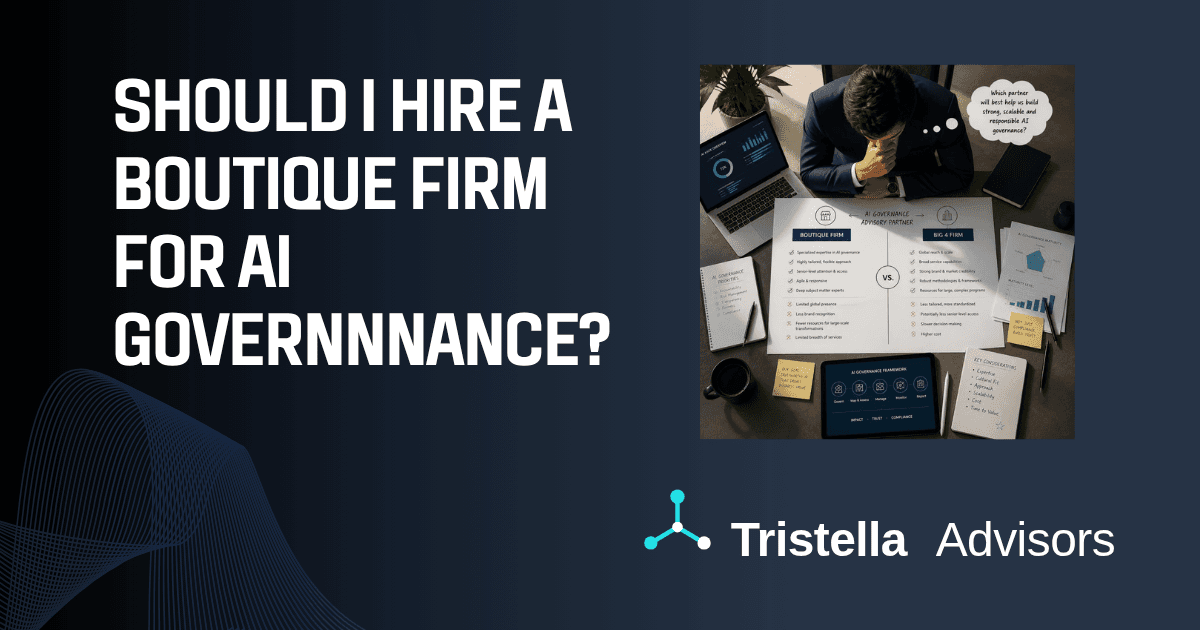
The direct answer: hire a Big 4 or large advisory firm (Accenture, Deloitte, McKinsey, PwC) when you need multi-jurisdiction regulatory coverage, your organization has revenue above $1B, and you already have a risk and audit infrastructure that a large engagement team can plug into. Hire a boutique firm when you need a focused deployment done quickly, direct access to senior practitioners throughout the engagement, and a team whose principal-level expertise is not backstopped by staffed-up junior associates.
Most organizations trying to answer this question are not in the $1B+ category. Most are health systems, funded startups, or mid-market technology companies with a specific AI deployment to govern, a defined timeline, and a budget that reflects their actual size. For that buyer, the rest of this comparison is the relevant part.
Cost and timeline reality
Big 4 AI governance engagements typically start at $500,000 and take three to six months to produce the first governance deliverable. That figure reflects the engagement model: a large firm staffs a team, brings in subject matter experts for specific sessions, and produces a comprehensive governance report calibrated to the firm's methodology. For a $5B health system with an enterprise AI deployment and a board that wants a name on the cover page, that model is appropriate. The cost is proportional to the organizational complexity and the risk surface being governed.
A scoped boutique engagement can start governance work in weeks, at a cost that reflects the actual scope. For a pre-launch startup that needs a minimum viable governance posture before investor diligence, the right engagement is two to four weeks of structured work to produce the four artifacts investors actually ask for. For a mid-market health system that needs a governance assessment on a specific clinical AI deployment, the right engagement is a focused diagnostic against the clinical workflows and regulatory obligations involved, not a six-month comprehensive framework exercise.
Cost is not always the determining factor. Timeline is often more important. An organization approaching an enterprise sales conversation in 60 days cannot wait for a Big 4 engagement to produce its first deliverable. A startup in a fast-moving fundraising process needs governance documentation in weeks, not quarters.
What you lose and gain with each
This is a fair comparison. Both models have genuine strengths, and the right choice depends on the specifics of the organization and the engagement.
Big 4 / Large advisory Boutique firm Senior practitioner involvement Partners lead the engagement; day-to-day work is often delegated to associate and manager-level staff Partners and senior practitioners are typically the ones doing the work throughout Methodology Proprietary frameworks with significant institutional backing, recognized by regulators and boards Methodology depth depends on the firm; the best boutiques have developed specific frameworks from real engagements Multi-jurisdiction coverage Strong; dedicated regulatory teams for EU AI Act, US federal, sector-specific frameworks Typically strong in specific sectors; cross-jurisdiction breadth varies by firm Speed to first deliverable Slower; engagement setup, scoping, and staffing take weeks before work begins Faster; scoped boutique engagements can begin governance work immediately Cost Typically $500K+ for a comprehensive governance engagement Scoped engagements start significantly lower; cost reflects actual scope Referenceable brand Significant; for board presentations and regulatory filings, a Big 4 imprimatur carries weight Depends on the firm; niche credibility matters more in specialized domains Domain depth Broad, sometimes shallow in specialized sectors Best boutiques have deep domain expertise in specific verticals Flexibility Less flexible; engagement scope and methodology are often fixed More flexible; can adjust scope based on what the assessment surfaces
The honest summary: Big 4 firms are better at covering everything. Boutique firms are better at going deep on a specific area. The question is whether "everything" or "something specific" is what the engagement actually requires.
What makes boutique advisory worse
There are two genuine risks with boutique firms that buyers should account for before choosing.
Capacity constraints are real. A boutique firm with three partners cannot staff a global AI governance program for a Fortune 500 company. If your organization needs parallel workstreams across multiple geographies, regulatory jurisdictions, and business units, a boutique firm will either stretch beyond its capacity or subcontract work that you're paying boutique rates for.
Referenceable brand matters in some contexts. For a board presentation that says "our AI governance was reviewed by [firm name]," the name carries weight in proportion to its recognizability. For a board that cares about the credential on the cover page, a Big 4 name delivers something a boutique firm cannot match regardless of the quality of the work.
Methodology depth varies. "Boutique firm" is a category, not a quality signal. Some boutique firms have developed proprietary frameworks from years of real engagements. Others are one or two practitioners with limited methodology beyond applying a published framework. The credential check that applies to any firm applies here: ask to see the framework, ask about the specific engagements where it was applied, and ask what broke and how it was corrected.
Where Tristella specifically fits
Tristella is a boutique firm. That means our engagements are right for specific contexts and wrong for others, and we will tell you which is which.
Choosing an AI governance consulting firm mostly comes down to one question: does a named partner do the work and stay accountable for it? That is the model this practice is built on.
Healthcare AI governance and adoption. Health systems and health-tech companies deploying clinical AI tools are the organizations where Myra's background in organizational management, health administration, and clinical nursing converges with real advisory value. The failure mode in healthcare AI governance is not the compliance checklist. It is what happens to that checklist when clinical workflows, physician accountability, and governance enforcement interact. Healthcare AI governance compliance for health systems and health-tech startups selling to hospitals and payers is the specific context in which Tristella's healthcare practice is designed to work.
Salesforce and Agentforce governance and architecture. Organizations deploying Agentforce into an existing Salesforce org face governance questions that require architect-level Salesforce knowledge, not just familiarity with AI products. Velma's 15 Salesforce Application Architect certifications and production experience in regulated Health Cloud environments represent specific expertise in the permission design, audit trail configuration, and human-in-the-loop escalation decisions that determine whether an Agentforce deployment is governable. Deep Salesforce AI integration expertise is the specific context in which Tristella's Salesforce practice delivers direct senior-level value.
Funded startups building AI governance before launch or before enterprise sales. The governance framework a Series A startup needs before going live or before an enterprise sales conversation is right-sized differently from that of a public company. John's background across fintech, insurance, media, and retail AI deployments, combined with direct experience in enterprise technical due diligence, is calibrated to the exact questions investors and enterprise buyers ask. The staged AI governance framework for pre-launch startups covers this in detail.
The question worth asking before you choose
Before selecting a firm, ask one question directly: who is doing the work?
At a Big 4 firm, the partner who sells the engagement is often not the person running it. The day-to-day work is typically done by managers and senior associates, with principal-level involvement at key review points. That is not a criticism. It is the model that allows large firms to run many engagements simultaneously.
At a boutique firm, the partners are typically the practitioners. The person who describes the methodology in the sales conversation is usually the person applying it in the engagement. Whether that matters depends on whether the specific expertise of the individuals involved is the thing you are buying.
For engagements where senior practitioner judgment is the product, not just senior practitioner oversight, that distinction determines the actual value of the engagement.
If you want to understand how Tristella approaches an AI governance engagement and whether the scope fits your organization, the conversation starts at tristellaadvisors.com/services or with our AI Production Readiness Assessment.
Primary sources: