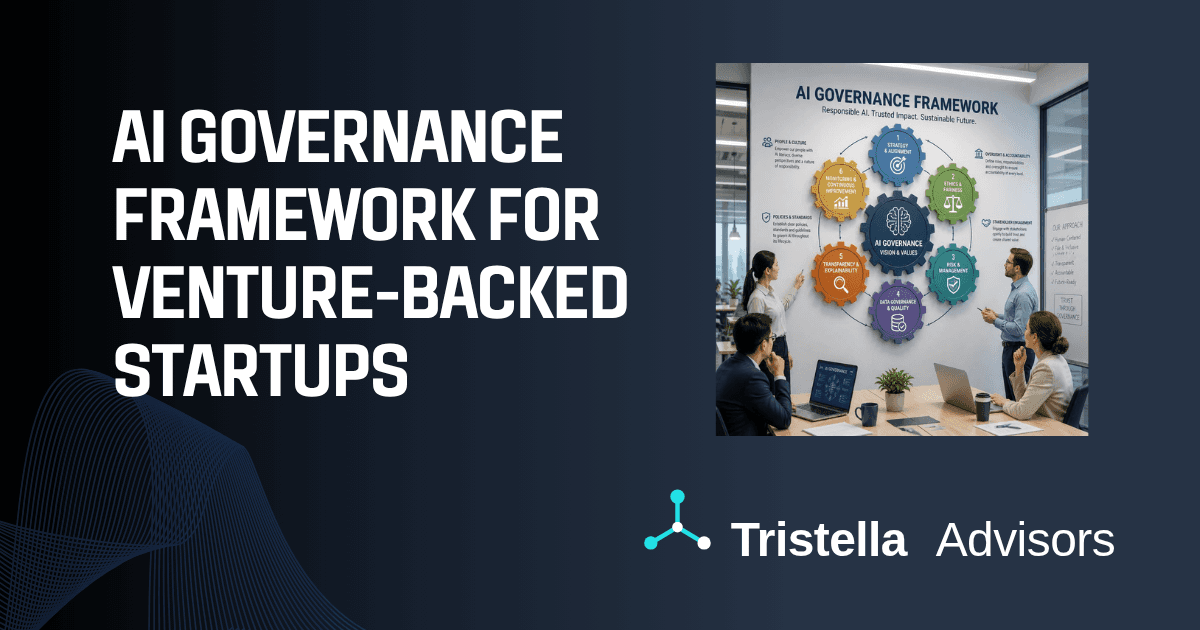
A funded pre-launch startup needs four things before going live with AI: an inventory of every AI system in the product and in internal operations, a use-policy document that defines what the AI does and does not decide, a named accountable owner (a person, not a team), and a one-page governance summary written for investors and enterprise buyers. That is the minimum viable governance posture. It can be built in two to four weeks. It is what the next diligence conversation will ask for.
Everything beyond that depends on whether you are entering a regulated market, pursuing enterprise sales, or preparing for Series B and above.
Why enterprise AI governance frameworks don't fit here
The two frameworks that appear in every AI governance conversation are NIST's AI Risk Management Framework and ISO/IEC 42001, the AI management system standard. Both are legitimate and eventually relevant. Neither is the right starting point for a seed or Series A company with a small team and a go-live date.
NIST AI RMF is a flexible, function-based framework organized around four core functions: Govern, Map, Measure, and Manage. The full framework is designed for organizations with existing risk management infrastructure. The NIST AI RMF Playbook, the lightweight companion document, is scoped for organizations earlier in their AI governance journey and is the version a pre-launch startup should actually read. A focused team can implement the Playbook's core governance actions within 2 to 4 weeks without a dedicated risk management function.
ISO/IEC 42001 is a full AI management system certification standard. Achieving certification requires establishing a documented management system, conducting internal audits, and engaging a third-party certification body. The process takes a minimum of three to six months and costs significantly more than most early-stage companies should spend on governance infrastructure. ISO 42001 becomes relevant when enterprise buyers in regulated industries require it as a procurement condition or when a company's own regulatory obligations require demonstrated conformance.
The mistake early-stage companies make is either skipping governance entirely (because it sounds like an enterprise concern) or treating enterprise-scale frameworks as the default (because they're the ones that appear in search results). Neither approach is right-sized. A pre-launch startup that skips governance entirely faces a harder conversation at Series B and with first enterprise customers. A pre-launch startup that pursues ISO 42001 certification before product-market fit is solving the wrong problem.
A staged governance framework for funded startups
The framework below is designed to scale with the company rather than requiring a complete rebuild at each stage. Each stage maps to a predictable inflection point in the funding and go-to-market timeline.
Stage 1: Pre-launch minimum viable governance (two to four weeks)
This stage produces the governance artifacts that investors and early customers will actually ask for. The deliverables are intentionally lightweight and designed for a small team to own without a dedicated compliance function.
AI use inventory. Document every AI system in the product and in internal operations. For each one, record what it does, what data it processes, what decisions it informs or automates, and who owns it. This does not need to be a formal register. A shared document with consistent fields is sufficient. The inventory forces the team to answer questions about their AI systems before a customer's security team asks them.
Use-policy document. Define what the AI does and does not decide. Specifically: which decisions are fully automated, which decisions are AI-assisted with human review, and which decisions the AI is explicitly excluded from making. Document the escalation path when the AI produces an output the system cannot handle. This document is the first thing an enterprise buyer's procurement team will request, and it is frequently the document that determines whether a deal advances past the security review stage.
Named accountable owner. Designate a specific person as the accountable owner for each AI system in the inventory. Not "the engineering team." A name. This person is accountable for monitoring the system's outputs, handling escalations, and making the call when the system behaves unexpectedly. In a small company, this is often the CTO or Head of Product. The point is that the name exists and is documented.
Investor and customer-facing governance summary. Write a one-page document that describes your governance posture in plain language: which AI you use, what it decides, who is accountable, and your data-handling commitments. This document streamlines the security questionnaire process and signals to enterprise buyers that the company has considered this before being asked.
Stage 2: Post-raise formalization (following Series A or first enterprise contract)
This stage maps the company's governance posture to the NIST AI RMF Playbook structure, which provides the vocabulary and function coverage that enterprise buyers recognize. The deliverables at this stage go deeper than those at Stage 1 without requiring the investment in full ISO 42001 certification.
Model documentation for each AI system, covering training data sources, known limitations, performance characteristics, and the conditions under which the system's outputs should not be trusted. An incident response procedure for AI system failures: what constitutes an incident, who is notified, the remediation process, and how the incident is documented. A risk categorization of AI use cases by potential impact, which informs the human review requirements for each category.
Stage 3: Enterprise-sale readiness (approaching Series B or regulated market entry)
Enterprise buyers in financial services, healthcare, and government will conduct technical due diligence, including a review of AI governance posture. Having worked through enterprise technical due diligence processes across fintech, insurance, and healthcare deployments, the question that consistently appears is: Where is your AI use inventory? What is your model documentation? What is your incident response procedure for AI system failures? Do you have a third-party assessment of your governance posture?
At this stage, an ISO/IEC 42001 gap assessment is worth commissioning, not to pursue certification immediately, but to understand the distance between the company's current governance posture and what certification would require. That gap assessment is also the due diligence package: it demonstrates to enterprise buyers that the company knows where it stands.
If you’re just getting started with AI governance or want to uncover your gaps, start with a free online AI Governance Gap Assessment.
A note from practice
Across AI deployments in fintech, insurance, media, and retail, the governance failures that produce the most expensive outcomes are not the ones that surface in audits. They're the ones that surface when an enterprise customer's legal team asks a question the company can't answer: who is accountable for this decision, and what happens when the system gets it wrong?
The startups that answer those questions clearly in the first sales conversation close enterprise deals faster than the ones that treat governance as a problem for later. It is not that enterprise buyers require perfect AI governance. They require evidence that the company has seriously considered the problem. Stage 1 above is sufficient for that signal in most cases.
Most funded startups do not need a full-time governance hire to get there. AI governance consulting is usually the faster path: a scoped engagement that produces the accountability model and the documentation, then hands both to your team to run.
For startups selling into healthcare, the governance requirements compound with regulatory obligations. Healthcare AI governance compliance encompasses the HIPAA, FDA SaMD, and ONC HTI-1 requirements that healthcare-facing companies must address, in addition to the staged framework above.
For startups building on Salesforce or integrating Agentforce into their product, the agent governance and permission design considerations are a specific addition to the general governance framework.
For companies weighing whether to engage a boutique firm or a larger advisory firm for governance work, the comparison of boutique versus Big 4 AI governance advisory is a direct reference for that decision.
If you are a funded startup and want an objective assessment of how your current AI posture compares to what investors and enterprise buyers will ask for, our AI Production Readiness Assessment addresses that question directly.
Need help solidifying your AI governance posture? Contact us.
Learn more about our AI architecture and governance practice at tristellaadvisors.com/services/fractional-cto.
Primary sources:
NIST: Artificial Intelligence Risk Management Framework (AI RMF 1.0)
White House Executive Order on Safe, Secure, and Trustworthy AI