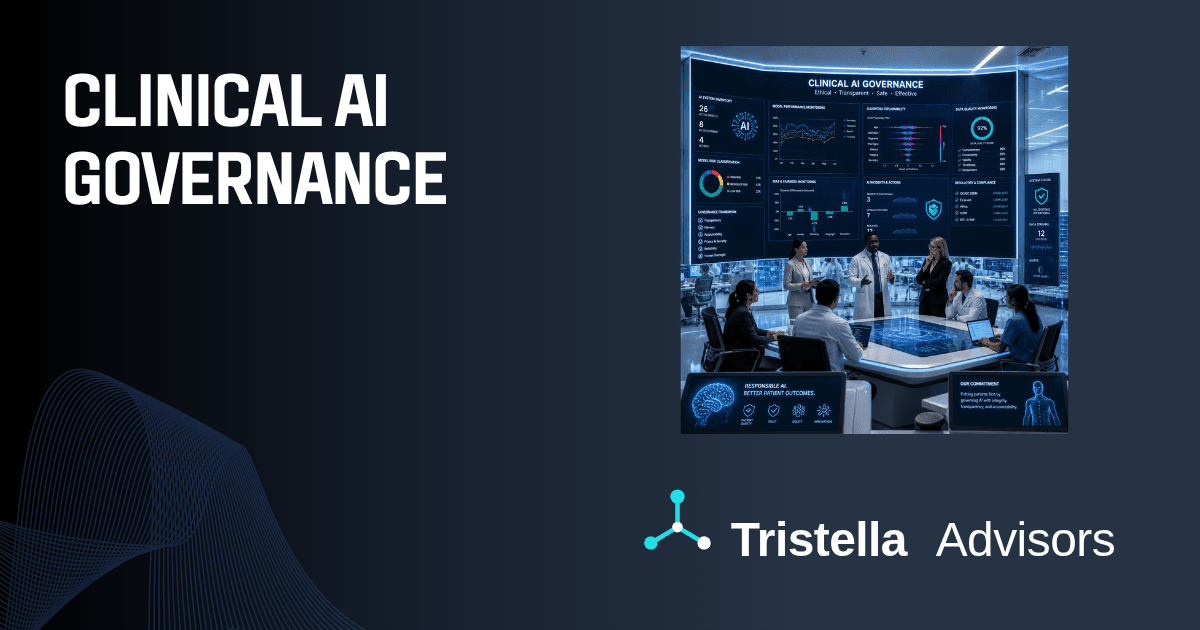
Clinical AI governance is the set of policies, processes, organizational structures, and technical controls that a health system uses to ensure that AI systems deployed in clinical and administrative workflows operate safely, accurately, equitably, and in compliance with applicable regulations throughout their entire operational life, not just at the point of deployment. It is distinct from general enterprise AI governance because the consequences of failure in a clinical environment include patient harm, regulatory enforcement, and civil liability at a level that most other industries do not face.
Understanding what clinical AI governance covers, how it differs from regulatory compliance, and what health system leaders are responsible for is now a prerequisite for any health system deploying AI in care delivery or clinical operations.
Why clinical AI governance is distinct from general AI governance
General enterprise AI governance addresses concerns that any large organization deploying AI must manage: bias in hiring or customer decisions, transparency in automated recommendations, data privacy, and regulatory alignment with frameworks like NIST AI RMF or the EU AI Act. These concerns are real and the governance frameworks built around them are useful.
Clinical AI governance addresses all of those concerns plus a distinct set that follows specifically from the healthcare context.
Patient safety and clinical risk. When an AI system produces an incorrect recommendation in a non-clinical context, the harm is typically financial or reputational. When an AI system misclassifies a clinical image, under-identifies a high-risk patient, or generates an erroneous medication recommendation, the harm can be physical. Clinical AI governance requires risk classification for every AI system based on clinical consequence, not just organizational impact.
FDA regulatory obligations. AI systems that qualify as Software as a Medical Device under FDA guidance, specifically those intended to aid in the diagnosis, treatment, or monitoring of a disease or condition, carry obligations that do not apply to enterprise software: premarket clearance or approval, post-market surveillance, real-world performance monitoring, and compliance with the August 2025 final guidance on predetermined change control plans. Under that guidance, manufacturers and, by extension, health systems deploying these devices must track model drift and document their monitoring approach within their quality management systems. This is not optional.
ONC transparency requirements. The ONC HTI-1 final rule requires that algorithmic clinical decision support tools expose their inputs, logic, and subgroup performance to the clinicians who use them. A CDS tool that cannot explain how it reached a recommendation, or whose vendor cannot provide subgroup performance data stratified by patient demographic, creates compliance exposure under this rule.
HIPAA-specific data obligations. The data that clinical AI systems train on, operate on, and produce is overwhelmingly protected health information. Clinical AI governance must address not just bias and accuracy, but the data access architecture: who can query what patient data, under what authorization, with what audit trail, and with what de-identification or data use agreement in place.
Equitable outcomes obligations. The research record on clinical AI bias is extensive, and the regulatory direction is increasingly clear. The Coalition for Health AI (CHAI), in its governance playbooks released in May 2026 (developed with 150 or more health AI leaders across more than 100 healthcare organizations), explicitly includes fairness and bias monitoring as a required element of responsible clinical AI implementation, alongside clinician oversight and post-deployment surveillance. Health systems that cannot demonstrate equitable outcomes across patient populations are exposed to both regulatory action and civil liability.
What clinical AI governance covers
A functioning clinical AI governance program addresses eight distinct areas. Organizations at early governance maturity often start with two or three of these and build toward comprehensive coverage; the specific starting point depends on the AI systems already deployed and the regulatory exposure they create.
AI system inventory. You cannot govern what you have not identified. A clinical AI inventory catalogs every AI system operating in the clinical environment: vendor-supplied, FDA-cleared, open-source, and internally developed. This includes models embedded in EHR platforms (Epic's deterioration index, readmission risk scores, ambient documentation tools), standalone clinical decision support tools, administrative AI (prior authorization review, scheduling optimization, revenue cycle), and any AI systems deployed by clinical departments without central IT oversight. The inventory is the foundation for everything that follows.
Risk classification. Not all clinical AI carries the same risk. A model that flags potential scheduling conflicts carries different governance requirements than a model that recommends chemotherapy agents. Risk classification assigns each AI system to a tier based on clinical consequence, regulatory classification (SaMD or not), reversibility of the decision it informs, and the degree of human oversight in the workflow. Higher-risk classifications require more intensive governance controls.
Pre-deployment validation. Before a clinical AI system goes live, governance requires validation against the clinical population the system will actually serve, not just the training population. This means testing for performance across demographic groups including race, age, sex, and insurance status, establishing the performance benchmarks against which post-deployment drift will be measured, and documenting the validation methodology in a form that supports regulatory review.
Ongoing monitoring and drift detection. Model performance degrades over time as patient populations shift, care practices change, and data distributions move away from what the model was trained on. Clinical AI governance requires continuous monitoring with defined thresholds for triggering review, recalibration, or suspension. For FDA-regulated AI devices, this monitoring is a regulatory requirement, not an optional quality practice.
Bias auditing. Clinical AI bias auditing goes beyond aggregate performance monitoring. It requires demographic stratification of model outputs: not just "the model's accuracy is 87 percent" but "the model's sensitivity is 91 percent for white patients and 73 percent for Black patients." The Optum algorithm documented in 2019 academic literature had acceptable aggregate performance while systematically excluding Black patients from care management programs at twice the rate of white patients with comparable health status. Aggregate metrics concealed the harm; demographic stratification revealed it.
Human oversight and escalation design. Clinical AI governance defines who is responsible when an AI system produces a flagged output, what the escalation path looks like, and what documentation is required when a clinician overrides an AI recommendation. The oversight design cannot exist only in policy documents; it must be embedded in clinical workflow. A governance program that sends alerts to a monitoring dashboard that no one reviews daily is not functional governance.
Incident response and reporting. When a clinical AI system produces an output that contributes to a clinical adverse event or near-miss, governance defines what happens: who is notified, what the investigation process looks like, what the regulatory reporting obligations are (including FDA Medical Device Reporting for SaMD), and what the remediation pathway is. Incident response in clinical AI is analogous to pharmacovigilance: you need a defined process before the incident, not after.
Documentation and audit readiness. Every significant AI governance activity, validation results, monitoring anomalies, bias audit findings, escalations, overrides, and model updates, should be documented in a form that supports regulatory review, accreditation surveys, and litigation discovery. The Joint Commission is developing a voluntary AI certification program aligned with the CHAI governance framework, and that certification will require documentation of governance activities, not just governance policies.
Clinical AI data governance
Clinical AI data governance is a specific subset of clinical AI governance concerned with the data that AI systems use, not the models themselves. It is worth addressing separately because health systems often have mature clinical data governance programs (data dictionaries, access controls, data quality standards) that do not automatically extend to AI-specific data requirements.
The data governance questions that clinical AI introduces are distinct from general clinical data governance. Training data provenance: can the organization document where the data used to train or fine-tune a model came from, what populations it represents, what time period it covers, and how it was de-identified? Many vendor-supplied models were trained on data that health systems never see and cannot audit; clinical AI data governance defines what transparency the organization requires from vendors about their training data.
Data access authorization for inference: when a clinical AI system queries patient data to generate a recommendation, what authorization framework governs that query? The ONC information blocking rules and FHIR access requirements create a floor for patient data access, but they do not design the authorization model for AI systems accessing PHI at inference time. Clinical AI data governance defines who can authorize an AI system's access to patient data, under what data use agreement, and with what audit log.
Feature data quality monitoring: AI model performance degrades when the quality of input data degrades. A risk stratification model trained on complete medication lists will degrade in performance if a workflow change results in medication lists being incompletely populated. Data governance for clinical AI extends monitoring to the input data quality, not just the model output.
Clinical AI governance vs. compliance
This distinction matters because the two are frequently conflated, and conflating them produces gaps that neither closes.
Compliance, in the healthcare AI context, is meeting a defined external requirement at a measurable point in time: demonstrating that your AI vendor has a Business Associate Agreement in place, producing documentation showing that a SaMD device operates within cleared specifications, or responding to an ONC information blocking inquiry. Compliance is necessary, auditable, and backward-looking.
Governance is the ongoing operational infrastructure that makes compliance achievable and that manages the risks compliance frameworks have not yet addressed. It is forward-looking, continuous, and organizational rather than transactional. A health system can be compliant with every current regulatory requirement and still have a clinical AI system producing biased outputs that cause systematic harm, because current compliance requirements do not yet mandate clinical outcome bias auditing for all AI deployments.
The gap between the two is significant. A 2026 survey found that only 23 percent of health systems have Business Associate Agreements in place for their third-party AI solutions, even though 66 percent of U.S. physicians actively use AI tools. That is a compliance failure. The governance failure that produced it is the absence of an AI inventory process that would have identified which vendors require BAAs before the AI tools were deployed.
The AI governance for healthcare post covers the specific HIPAA compliance obligations that clinical AI governance must address, including BAA requirements, minimum necessary standards for PHI in AI queries, and the information blocking rules.
Clinical AI governance for CIOs
Health system CIOs in 2026 are navigating a governance responsibility that is larger and more complex than the technology leadership role they held five years ago. Clinical AI governance sits at the intersection of IT, clinical quality, compliance, legal, and executive leadership, and the CIO is typically the convener of that intersection rather than the sole owner.
The organizational structure question is the first one to answer: who owns clinical AI governance? The options range from a dedicated AI governance committee (the CHAI framework recommends this model) to governance embedded in the existing clinical quality and patient safety infrastructure to a distributed model where department chairs own AI governance for their service lines. The right answer depends on organizational culture and existing governance infrastructure, but the wrong answer is no clear owner, because diffuse ownership produces diffuse accountability.
Vendor management obligations are expanding. CIOs are now responsible not just for procurement decisions but for ongoing vendor governance: verifying that vendor models continue to perform as warranted, that updates are communicated and validated before deployment, that BAAs are current, and that vendor transparency obligations (training data demographics, subgroup performance, known limitations) are being met. The ONC HTI-1 transparency requirements make some of these obligations regulatory rather than contractual.
The human oversight problem is particularly acute for CIOs. Clinical AI systems that produce outputs at scale in clinical workflows, a deterioration alert system processing tens of thousands of patient records per day, an imaging AI reviewing every radiology study, create a volume of outputs that exceeds any human's capacity to review. Governance requires defining which outputs require human review (all high-risk outputs, all overrides of prior recommendations, all outputs in specific clinical contexts), what the review workflow looks like, and what happens when review volume exceeds reviewer capacity.
The practical framework for CIOs is covered in depth in the clinical AI governance framework post, which addresses committee design, risk tiering, vendor management programs, and the documentation infrastructure that clinical AI governance requires.
Clinical AI governance best practices
Several patterns consistently distinguish health systems with functioning governance programs from those with governance frameworks that exist on paper.
Embed governance in existing clinical infrastructure. Governance that lives in IT does not reach clinical staff. Health systems with effective clinical AI governance integrate AI performance monitoring into existing clinical quality dashboards, include AI-related adverse events in morbidity and mortality review processes, and assign AI oversight to existing clinical roles (CMIOs, patient safety officers, quality directors) rather than creating a parallel governance structure that clinical staff never interact with.
Start with the highest-risk AI in use. An organization that attempts to govern all AI simultaneously rarely governs any AI well. Risk classification allows governance resources to concentrate where clinical consequence is highest: FDA-regulated devices first, then high-volume clinical decision support, then administrative AI. This sequencing produces meaningful governance faster than a comprehensive program that takes two years to implement.
Define thresholds before deployment. The monitoring question "has this model's performance degraded" only has a meaningful answer if the baseline and the acceptable deviation range were defined before the model went live. Post-deployment threshold-setting produces thresholds set around observed performance rather than clinically meaningful benchmarks, which can normalize gradual degradation.
Require subgroup performance data from vendors. Most clinical AI vendors can provide overall model performance metrics on request. Fewer will proactively provide performance stratified by patient race, age, sex, insurance status, and geographic region. A governance program that accepts only aggregate metrics cannot detect the bias patterns that have produced documented harm in deployed clinical AI. Make subgroup performance data a procurement requirement, not a post-hoc request.
Document the override, not just the alert. Clinical AI governance that tracks alerts but not clinician responses to those alerts misses the most important governance signal: when clinicians consistently override an AI recommendation, either the recommendation is wrong, the clinical context makes it inapplicable, or the workflow design makes it unintelligible. Tracking overrides with structured documentation captures this signal and feeds quality improvement for both the AI system and the governance workflow.
The AI governance failures post documents what happens when these practices are absent, with documented costs, regulatory consequences, and legal outcomes across six cases spanning healthcare, criminal justice, public benefits, and hiring.
How Tristella approaches clinical AI governance
Tristella's clinical AI governance advisory practice works with health systems, payers, and medtech organizations on governance programs that are functional in real clinical environments, not just compliant on paper. The distinction matters because governance frameworks designed without clinical workflow context produce policies that clinical staff cannot follow, documentation requirements that IT teams cannot technically fulfill, and escalation procedures that do not map to how the organization actually makes decisions.
The Polaris AI Risk Management Framework is Tristella's proprietary structure for clinical AI governance, covering risk classification, pre-deployment validation requirements, monitoring thresholds, bias auditing protocols, incident response design, and the documentation infrastructure that regulatory review requires. It is designed to map to the CHAI governance playbook requirements, FDA post-market surveillance expectations, and HIPAA obligations within a single integrated framework rather than requiring three separate compliance programs.
For health systems that have not yet structured a governance program, the AI governance gap assessment identifies where the exposure is before a regulator or accreditor identifies it. The assessment covers model inventory, policy framework maturity, monitoring infrastructure, escalation design, and documentation, and produces a prioritized view of what needs to be addressed and in what order.
For health systems evaluating where AI governance fits alongside other clinical IT priorities, the healthcare AI adoption scorecard covers FHIR readiness, AI infrastructure, and governance maturity in a single assessment.
Myra Salapare leads Tristella's healthcare IT strategy and clinical AI practice. Contact us to discuss your organization's clinical AI governance posture.
Related reading: