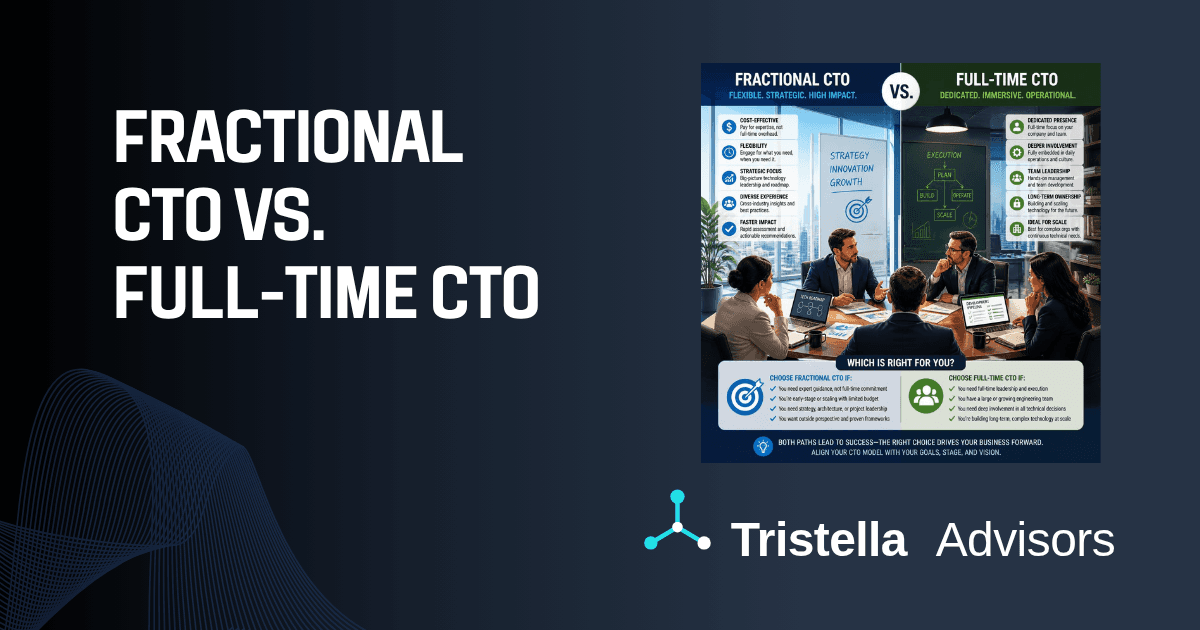
The fractional CTO and the full-time CTO are not competing versions of the same job. They are the right answer to different questions at different stages of a company's life. The choice between them is less about quality or commitment and more about whether the scale of the problem justifies a full-time seat, and whether you can wait the six to twelve months a full-time search typically takes.
This post compares both models across the dimensions that actually matter: what each provides that the other does not, the real 2026 cost difference, which stage and situation each fits, how to recognize when the fractional model has run its course, and how the transition from one to the other typically works.
The core structural difference
A full-time CTO is a member of your leadership team with total organizational focus on your company. They are in every meeting, available for the late-night infrastructure incident, embedded in the engineering culture, and compounding institutional knowledge that does not walk out the door at the end of an engagement. Their accountability is undivided.
A fractional CTO works with your company on a defined cadence, typically 10 to 20 hours per week. They bring deep expertise and senior judgment to the decisions that require it without the cost of a full-time executive headcount. Their accountability is real but bounded: they own the work within the engagement, and the engagement has a defined scope that a full-time role does not.
Neither model is inherently better. What matters is whether the scale of your technical leadership need justifies the full-time structure, and whether your budget and timeline support it.
What the full-time model provides
Total organizational focus. A full-time CTO knows the company at a depth that a part-time engagement cannot replicate. They know which engineers are struggling before it shows up in output. They know the politics behind a technical decision before it becomes a conflict. They know the product roadmap context behind an architecture question before the question gets asked. That depth of organizational knowledge accumulates over months and years and cannot be replicated by 15 hours per week.
Constant availability. When a production incident happens at 2 a.m., when a board member calls with a concern on a Friday afternoon, when an enterprise customer's security team emails with a list of questions that need answers before Monday: a full-time CTO is there. A fractional CTO is not, at least not on the same terms.
Long-term culture building. Engineering culture is set by the senior technical leader. Code review standards, architectural norms, the expected level of documentation, how the team handles failure, what good engineering looks like: these things are shaped by someone who is present every day over a long period. A fractional CTO can set standards and model behavior, but culture is ultimately built by consistent presence.
Board and investor confidence. At certain stages, particularly late Series B and beyond, investors and board members want a named, full-time technical leader who is fully accountable for the company's technology decisions. A fractional CTO can handle investor due diligence and board presentations effectively, but a sophisticated board at a capital-intensive stage increasingly expects a full-time CTO on the executive team.
What the fractional model provides
Senior judgment at a fraction of the cost. The most obvious advantage is the cost structure. A full-time CTO at a growth-stage startup costs $400,000 to $650,000 per year all-in once you account for base salary, equity, bonus, and benefits, based on 2026 executive compensation data from KORE1. A fractional engagement at 10 to 20 hours per week runs $10,000 to $25,000 per month, or $120,000 to $300,000 per year. For a company that needs senior technical judgment but does not yet need 50 hours per week of a CTO's time, the fractional model is not a compromise. It is the right allocation of capital.
Speed of deployment. A full-time CTO search takes three to nine months when done well. A fractional engagement can start within two to four weeks. For companies facing an urgent technical decision, a CTO departure, or a time-sensitive fundraise, the fractional model is often the only option that fits the timeline.
Cross-company pattern recognition. A fractional CTO working with multiple companies simultaneously brings something a full-time hire typically cannot: pattern recognition from other organizations facing similar problems right now. They have seen the vendor that just pitched you at three other companies. They know how a similar architecture decision played out elsewhere. That lateral knowledge has real value, particularly at decision points where your company lacks the internal history to learn from.
Lower risk at an uncertain stage. A fractional engagement can be adjusted as the company's needs evolve. If the technical problem turns out to be different from what was expected, the scope changes. If the company's stage changes quickly, the engagement changes with it. A full-time hire is a long-term organizational commitment with real cost and disruption to unwind if the fit is not right.
A defined path to the full-time hire. The best fractional CTO engagements end with a transition: the fractional CTO has built the governance infrastructure, documented the architecture, and established the team culture that makes the company ready to bring on a full-time CTO. They have also, in many cases, helped define and recruit for that full-time role. That transition outcome is healthier than indefinitely extending a fractional model beyond its useful life.
The category error: when you need a VP of Engineering, not a CTO
Before comparing fractional and full-time CTO models, it is worth asking whether you need a CTO at all. Many companies that are evaluating CTO options actually have a VP of Engineering problem, not a CTO problem.
The CTO is an outward-facing role: technology strategy, investor and board engagement, architectural bets, enterprise customer credibility, and the company's technology roadmap over a multi-year horizon. The VP of Engineering is an inward-facing role: engineering team management, delivery execution, hiring, process discipline, and the organizational health of the engineering function.
If your engineering team is not delivering reliably, if sprints are chaotic, if engineers are confused about priorities or not performing: that is a VP of Engineering problem. Hiring a fractional or full-time CTO to fix a management execution gap is a category error that costs time and money without addressing the actual issue. Diagnose which gap you have before you decide how to fill it.
A stage-based decision framework
Seed and pre-seed. At this stage, almost no company can justify a full-time CTO on cost grounds alone, and most cannot find one willing to join at the salary a seed-stage company can offer. Fractional is the right model. The engagement covers architecture oversight, engineering hiring, technical narrative for fundraising, and the guardrails that prevent non-technical founders from making expensive mistakes. If a seed-stage company has a technical co-founder with genuine CTO-level experience, that person fills the role. If not, fractional is the answer.
Series A. This is the stage where the question becomes real. Series A companies are building their first real engineering team, making architecture decisions they will live with for years, and preparing for the technical due diligence that a Series B investor will conduct. A fractional CTO covers this work effectively for most Series A companies. The trigger for a full-time hire at this stage is specific: if the engineering team has grown past 15 to 20 people and is moving fast enough that a part-time senior leader creates coordination gaps rather than closing them, or if the company's fundraising target and board expectations require a named full-time CTO, the transition is warranted.
Series B. This is where most companies should be transitioning from fractional to full-time if they have not already. Series B companies typically have 20 to 60 engineers, a product that is moving fast, and enterprise sales cycles that require a credible full-time technical leader. The fractional model can still work at Series B if the engineering team is not yet at a scale that requires constant senior presence, but the pressure to hire full-time increases with round size.
Series C and beyond. A full-time CTO is almost always the right answer. The engineering organization is large enough to require daily senior leadership, the board expectations have shifted, and the organizational complexity of managing a multi-team engineering function part-time creates more problems than it solves.
Post-CTO departure (any stage). This is a special case regardless of stage. When a CTO leaves, the right immediate answer is almost always fractional, even if the company is at a stage that would normally warrant full-time. The fractional CTO provides continuity while the company runs a thorough full-time search without the pressure of having no senior technical leadership during the process.
The 2026 cost comparison
Based on current market data:
Full-time CTO total employer cost by stage:
At Seed/Series A: $150,000 to $220,000 base salary, plus 1% to 5% equity grant at the current valuation, plus employer payroll taxes and benefits. Total annual cost to the company, excluding equity, is typically $200,000 to $320,000.
At Series B through D: $250,000 to $350,000 base, plus 0.25% to 1% equity, plus annual bonus of 20% to 40% of base, plus benefits. Total all-in employer cost runs $400,000 to $650,000 per year.
At enterprise scale: $320,000 to $450,000 base, with total compensation routinely exceeding $600,000 and reaching $1,200,000 or more at large public companies.
Fractional CTO cost:
$10,000 to $25,000 per month for 10 to 20 hours per week of senior practitioner time, or $120,000 to $300,000 annually. Domain specialization carries a premium: a fractional CTO with deep expertise in healthcare AI, financial services compliance, or government technology commands a higher rate because the specialized knowledge shortens the learning curve and reduces the risk of guidance that fails the domain-specific test.
The math: At the growth stage, the fractional model runs at roughly 30% to 50% of the all-in cost of a full-time hire. The tradeoff is engagement depth and constant availability. For a company at the stage where 10 to 20 hours per week of senior technical judgment covers the actual need, the cost structure is not a compromise.
What the transition from fractional to full-time looks like
The fractional-to-full-time transition is a specific project, not just a decision to start hiring. The companies that handle this transition well do several things.
They start the search before the fractional engagement ends. A full-time CTO search takes three to nine months. Starting it only after deciding to transition means three to nine months without senior technical leadership. The fractional CTO should be actively supporting the search while still engaged.
They use the fractional CTO's knowledge to define the full-time role. After months inside the company, the fractional CTO knows what specific gaps the full-time CTO needs to fill, what the engineering team needs in a permanent leader, and where the prior technical strategy has worked or not. That knowledge produces a better job description than a generic CTO template.
They involve the fractional CTO in the evaluation process. The fractional CTO can assess technical candidates in ways that a founder or non-technical board member cannot, and can assess cultural fit with the engineering team from a position of real organizational knowledge.
They invest in knowledge transfer. The institutional knowledge built during a fractional engagement needs to be documented: architecture decision records, technical roadmap rationale, team assessments, vendor relationship context, and anything else the incoming CTO needs to understand the current state without spending months rediscovering it. A fractional CTO who leaves behind a well-documented handoff produces a better outcome than one who hands over a Slack history and a few Confluence pages.
The companies that handle this badly are the ones that treat the full-time hire as the end of the fractional engagement rather than as the goal it was building toward.
The hybrid model
Some companies run both simultaneously: a fractional CTO covering the strategic and external-facing dimensions while a VP of Engineering covers the operational and team management dimensions. This model works when those two layers need to be separate, typically at a growth-stage company moving too fast for a single part-time senior leader to cover both but not yet large enough to justify a full-time CTO at market rate plus a VP of Engineering.
It is an expensive model and creates coordination overhead. It is the right answer for a specific phase and should be treated as a transitional structure rather than a permanent one.
Where Tristella fits
Tristella Advisors' fractional CTO services are designed to produce one of two outcomes: either building the governance, architecture, and team foundation that makes a company ready for a full-time CTO hire, or providing sustained fractional coverage for a company at a stage where the fractional model is the right permanent answer.
Every engagement starts with an assessment that makes the stage question explicit: is this company building toward a full-time hire, or is the fractional model the right long-term structure? That answer shapes the engagement from the start. Our AI governance and architecture expertise, applied through the Polaris framework, is a specific deliverable in either case: the governance documentation and architecture design that a full-time incoming CTO can build on, or that holds up under enterprise customer and investor scrutiny in an ongoing fractional relationship.
Learn more about fractional CTO engagements at tristellaadvisors.com/services/fractional-cto, or start with the AI Production Readiness Assessment if AI architecture is the specific problem in front of you.
Related reading:
Sources: