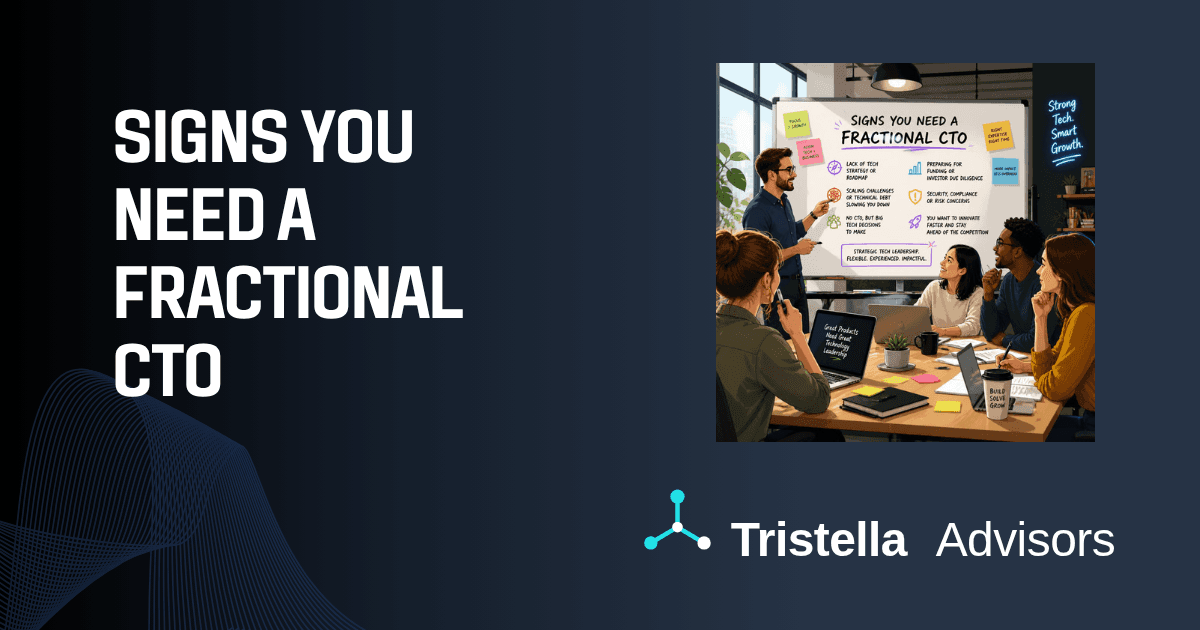
The clearest sign you need a fractional CTO is that a consequential technical decision is in front of you, and no one on your team has made it before. That is the version most founders notice. The version they often miss is the slower-moving one: the accumulation of technical choices made without senior judgment that have quietly constrained the business without anyone naming them as the cause.
This post covers ten specific patterns that signal a fractional CTO engagement would produce real value. Not every sign applies to every company. But if two or three of these describe your situation, the engagement cost is almost certainly lower than what the gap is costing you.
1. You are a non-technical founder, and you cannot independently evaluate your engineering team's decisions
This is the most common situation and the one most founders underestimate. The problem is not that you lack technical knowledge. The problem is that when your lead engineer tells you "we need to rebuild the authentication layer" or "we should switch to a microservices architecture," you have no way to assess whether that recommendation is correct, premature, or a solution in search of a problem.
This information asymmetry has real costs. Engineers sometimes advocate for interesting technical problems over the ones the business actually needs solved. Vendors pitch solutions that create dependencies that serve the vendor more than the company. Agencies build things that work until they do not scale, and by then the agency is paid and gone.
A fractional CTO changes this dynamic by giving you a senior technical reader for the decisions coming across your desk. Not someone who does the engineering, but someone who can tell you whether the recommendation you received is sound before you commit to it. That function is worth the engagement cost before you need it for anything else.
2. Your engineering output keeps needing to be redone
If the pattern across your product history looks like build, ship, partially work, rebuild, that is a signal. Some iteration is normal. Consistent rework is a signal that the original architectural decisions were wrong, that the quality bar was not set correctly, or that the team lacks the senior oversight to catch problems before they become embedded in production.
Rework is expensive in ways that do not show up cleanly in any line item. It consumes engineering capacity that should be going toward new product capability. It creates morale problems on teams that are skilled enough to know they are building the same thing twice. And it compounds: each rebuild generates its own technical debt and a set of trade-offs that will surface as the next thing to be redone.
The root cause is usually that the decisions made at the start of each build cycle lacked senior review. A fractional CTO does not prevent all rework. It does prevent the category of rework arising from architectural decisions that a more experienced technical leader would have caught early.
3. You lost an enterprise deal (or almost did) because of technical due diligence
Enterprise buyers send security questionnaires. They want SOC 2 reports, or evidence that SOC 2 is in progress. They ask about your data-handling practices, your encryption standards, your incident-response process, and, increasingly, your AI governance posture. The answers to these questions have to be documented, not improvised.
Companies without senior technical leadership tend to discover this requirement mid-sales-cycle, when a prospective customer's security team sends a 200-question questionnaire and the honest answer to most of it is "we handle that informally." The deal either dies, stalls while you scramble to put the documentation together, or closes on a verbal commitment, creating a compliance gap you now have to close under contract pressure.
A fractional CTO builds the documentation, security posture, and governance framework that enterprise buyers are looking for before they ask. That work is part of the engagement, not a separate project. It makes enterprise sales cycles shorter and more predictable, because you have answers before the questions come.
4. You are preparing to raise a round, and investors are asking technical questions you cannot answer with confidence
Technical due diligence is standard at Series A and above. Investors and their technical advisors will ask about your architecture, your infrastructure spend relative to revenue, your engineering hiring process, your technical debt backlog, and your team's ability to scale. They will ask how you have thought about AI, how you govern it, and what your roadmap looks like for the next eighteen months.
Founders who have not had a senior technical leader involved in the business often discover during fundraising that the technical narrative they have been telling does not align with what an investor's technical review finds in the code and infrastructure. That gap is fixable, but it is better to fix it before the process starts than during it.
A fractional CTO prepares you for technical due diligence by ensuring that the architecture is defensible, that documentation exists, and that the technical narrative accurately reflects the state of the business. They can also participate in investor conversations directly, giving investors a credible technical voice to engage with.
5. Your CTO just left (or you know they are about to)
CTO departures create gaps that compound quickly. The engineering team loses its senior decision-maker. In-flight technical decisions stall or get made by whoever has the most confidence rather than the most context. Institutional knowledge about architectural decisions, vendor relationships, and technical trade-offs is starting to walk out the door.
The typical response is to immediately start a full-time CTO search. That search takes a minimum of three to nine months for a role done well. The gap between the departure and the new CTO's first day is where damage accumulates: technical debt, team attrition, missed architecture decisions, and product delays.
A fractional CTO fills that gap within weeks, not months. The engagement preserves continuity, keeps the engineering team directed, and produces the documentation that a new full-time CTO will need to understand the current state when they arrive. In some cases, the fractional CTO's involvement also informs what the company actually needs from a full-time hire, a question that looks different after three months of working inside the business.
6. Technical debt is actively limiting what you can ship
Technical debt is not inherently a problem. Some technical debt is the correct tradeoff at an early stage: move fast now, clean it up when you have the runway. The problem is that when that debt is not managed and accumulates to the point where it limits what the engineering team can deliver.
The signal is usually a pattern of engineering estimates that keep getting longer without a clear technical rationale, or a roadmap constrained by infrastructure concerns rather than product decisions. When engineers spend more time working around the existing system than building on top of it, the debt has reached the point where it is a business constraint.
Managing technical debt well requires senior judgment about which debt is load-bearing (must be fixed before it creates a crisis), which is structural (should be addressed in the next major roadmap cycle), and which is cosmetic (can be ignored indefinitely without real consequence). Without that judgment, companies either let all the debt accumulate until it causes a crisis, or they dedicate engineering capacity to cleaning up debt that did not need cleaning.
A fractional CTO produces a debt assessment and a prioritized remediation plan, then works with the team to address the highest-risk items without stopping new product development. That is a different outcome from hoping the team finds time to clean things up between features.
7. You are shipping AI features without anyone who has shipped AI in production before
Most companies are adding AI capabilities to their products right now. Most of them are doing it without anyone on the team who has been through the failure modes that happen when AI systems go into production: model drift, data quality problems, prompt injection vulnerabilities, AI outputs that work in testing and fail in edge cases, governance questions that surface when an enterprise buyer asks how you manage AI risk.
Shipping an AI feature is not the same as operating an AI-enabled product. The integration is relatively fast. The operational design, the monitoring, the governance, and the architecture for what happens when the AI does something unexpected are where companies without experienced AI leadership get into trouble.
If your product roadmap has AI features and your team's experience with AI is primarily at the prototype or demo layer, a fractional CTO with production AI experience is the right call before you ship into a customer environment. The problems that show up in production AI are predictable to someone who has seen them before and are expensive and reputationally damaging to discover for the first time in front of customers.
8. Your engineering team is growing, but no one is setting the technical culture
There is a phase of engineering team growth where things start to break down without anyone being able to name exactly why. Code quality becomes inconsistent. Onboarding new engineers takes longer than it should. Architectural decisions are increasingly made by whoever writes the first pull request rather than by any deliberate process. Small technical decisions that are actually important get made without the right people in the room.
This happens when an engineering team grows past the point where informal coordination works, usually somewhere between 5 and 15 engineers, without a senior leader who is explicitly setting standards, establishing code review practices, creating the technical decision-making process, and modeling the engineering culture you want.
A fractional CTO fills this role at the senior level. They establish the architecture decision record process, code review standards, technical interview rubric, and norms that enable the team to grow without quality degrading. That cultural infrastructure is harder to build retroactively than it is to put in place as the team grows.
9. You are in a regulated industry, and your compliance posture is based on intention rather than documentation
Healthcare organizations, fintech companies, companies selling to government buyers, and companies processing regulated data all have compliance requirements with real consequences if not met. The problem is that most early-stage companies in these sectors handle compliance based on good intentions rather than documented controls.
"We are careful with patient data" is not a compliance posture. "We have implemented these specific technical controls, documented here, and reviewed them on this cadence by this named person" is. The gap between the two surfaces during enterprise sales cycles, investor due diligence, regulatory inquiries, and audits.
A fractional CTO who has worked in your regulated environment builds the compliance architecture from a technical perspective: what controls need to exist, how they are configured, documented, and maintained. This is different from legal or compliance advisory. It is the engineering implementation of the compliance requirement, which is where most companies are actually behind.
10. Your board keeps getting surprised by technical issues
If the pattern in your board meetings looks like "the engineering timeline slipped because of [technical reason the board had not heard about]" or "we discovered [infrastructure/security/compliance issue] that is going to require [unexpected investment]," the board is not getting an accurate picture of the technical state of the business between meetings.
This is as much a senior technical communication gap as it is a technical problem. A fractional CTO translates the business's technical state into terms the board can engage with: the risks, the investment requirements, the alternatives, and the recommendation. That communication function prevents surprises and provides the board with the context to make sound decisions about technical investment.
The related version is a board that keeps asking hard technical questions the founder cannot answer. That is not a reflection of board aggressiveness. It is a signal that the board lacks sufficient technical visibility to assess whether the company's technology risk is being managed appropriately.
Signs that do not mean you need a fractional CTO
Worth naming, because hiring the wrong role for the right problem is an expensive mistake.
If your core problem is that the engineering team is not delivering reliably, that standups are chaotic, that sprint planning is not working, or that individual engineers are underperforming, the gap is at the engineering management layer, not the CTO layer. A VP of Engineering or an experienced engineering manager solves that problem. A fractional CTO who is brought in to fix a delivery execution problem will spend their time on the wrong work.
If your problem is a lack of engineering capacity, a fractional CTO is not the answer. More engineers are the answer.
And if you have a capable full-time CTO who is simply stretched across too many responsibilities, the solution is usually to take something off their plate, not to add a second senior technical leader.
What to do if you recognize these signs
The fastest way to get a calibrated picture of where your technical leadership gap actually sits is to take the AI Production Readiness Assessment if AI architecture is the specific concern, or to book a direct conversation at tristellaadvisors.com/contact to talk through the specific pattern in front of you.
Tristella Advisors' fractional CTO practice is structured around the situations described in this post: non-technical founders who need technical oversight, companies preparing for enterprise sales or fundraising, organizations adding AI to their product stack without production AI experience, and engineering teams that are growing without a senior culture-setter. Every engagement starts with an assessment of the current technical state and the specific gap to be closed, then builds toward outcomes rather than a defined number of hours per week.
Learn more about how we structure fractional CTO engagements at tristellaadvisors.com/services/fractional-cto.
Related reading:
Fractional CTO Services for New York, California, Washington DC, and Beyond
What Enterprise Buyers Ask About AI Governance Before Signing a Contract
What AI Governance Framework Do Venture-Backed Startups Need Before Launch?
Sources: